From about the middle of September, the same enquiry starts arriving at our Surat office in almost identical words. A family wants to see the northern lights, they have seen the photographs, and they want to know which three nights to book. It is one of the most rewarding trips we plan, and also the one where we spend the most time managing expectations before anyone pays a rupee.
Tromso, a Norwegian city of about seventy thousand people at roughly 69 degrees north, is where we send most of those families. Here is why, and everything we would tell you across the desk before you commit.
Why Tromso, and not Alta, Kiruna, Rovaniemi or Iceland
Tromso sits almost directly beneath the auroral oval, the ring of concentrated activity around the magnetic pole. Several places do. What Tromso adds is roads in every direction. A guide can drive you east towards the Finnish border, south into the Lyngen valleys, north up the coast or across towards Sweden within a few hours. If the coast is smothered in cloud, inland is often clear. That mobility is the actual product you buy when you book a Tromso aurora tour: someone who spends the evening reading cloud maps and driving until they find a hole in the sky.
The alternatives are genuinely good and we book them too. Alta has drier inland weather and a famous ice hotel. Kiruna and Rovaniemi are more sheltered from Atlantic weather and better suited to families who want husky farms and snow activities as the main event. Iceland is easier to reach and spectacular, though it sits lower in latitude with volatile maritime weather. Tromso's advantage is not superiority; it is the combination of high latitude, an international airport, a walkable town with hotels and restaurants, and escape routes in four directions.
The honest part: nobody can guarantee you the aurora
We say this plainly because too few people do. The aurora needs two independent and genuinely unpredictable things to align: solar activity, and a clear sky directly above wherever you are standing. No operator, agency or app controls either one. Any brochure that promises you the lights is selling something it cannot deliver.
The practical implication is your most important booking decision. Treat every single night as a coin flip. Book at least three dark-season nights in Tromso, and four or five if the budget allows. We have had clients see nothing on nights one, two and three, then get a display on night four they still talk about years later. This is also why we steer people away from one-night aurora packages bolted onto a wider European tour. A single evening in Tromso is not an aurora trip, it is a lottery ticket with a hotel attached.
KP numbers, cloud cover, and what your eyes will really see
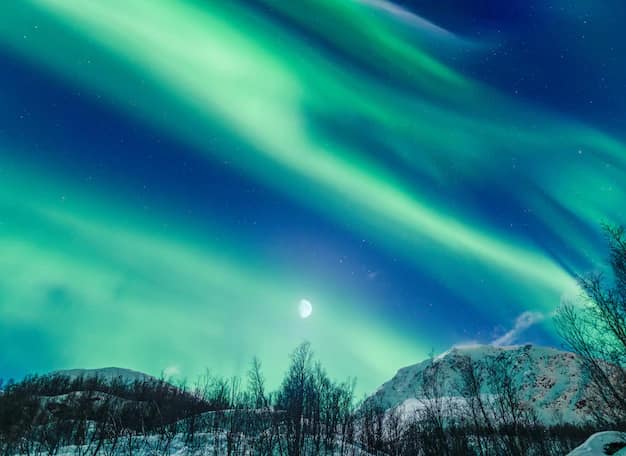
The KP index is a 0 to 9 scale of global geomagnetic disturbance; higher numbers mean the auroral band widens and pushes further south. The part travellers rarely hear is that Tromso sits under the oval even at low KP, so a 2 or a 3 can produce a beautiful overhead display. Do not sit in your hotel refreshing an app waiting for a big number. Cloud is what actually decides your night, which is why the person driving the minibus matters more than the forecast. Ask operators about group size, how far they will drive, and whether there is a warm vehicle to retreat into.
Set your eyes' expectations too. To the naked eye a weak or moderate aurora often looks like a pale grey-white arc that will not drift with the wind, because the human eye sees little colour in low light. Cameras gather over a long exposure what your retina cannot, which is why every photograph looks more saturated than reality. Strong displays do show vivid green, sometimes with pink edges, and when they start dancing they are overwhelming. Bring a small tripod, since handheld long exposures fail; modern phones with night mode do surprisingly well propped on something solid.
Choosing your season: polar night, equinox and midnight sun
The viewing season runs roughly late September to late March, simply because that is when the sky is dark. The periods around the equinoxes, late September and late March, are statistically associated with stronger activity and also give you milder weather and a normal cycle of day and night for sightseeing.
The Polar Night, roughly late November to mid-January, is when the sun never climbs above the horizon. It is not blackness. Around midday the sky glows in a long, soft blue twilight, with snow reflecting it back until the whole town looks lit from inside a sapphire. It is beautiful and strange, and some visitors find it disorienting by day three, which is worth weighing if you are travelling with anyone who sleeps poorly in low light; our notes on taking senior citizen parents abroad from Gujarat cover that ground. The opposite extreme, the Midnight Sun from roughly late May to late July, is a completely different and equally worthwhile trip of hiking and fjord cruising, with no aurora at all.
Getting to Tromso from Surat, Ahmedabad or Vadodara
There are no direct flights from India. Every routing has two legs and usually three: a Gulf hub into Oslo and then a domestic hop to Tromso, or a European connection through Helsinki, Stockholm, Copenhagen, London or Amsterdam, some of which run seasonal services straight to Tromso and save you the Oslo transfer. We weigh these against departures from Ahmedabad and Mumbai, as set out in our overview of international flights from Gujarat airports.
One detail catches people out repeatedly. The final domestic leg is often flown by a regional or low-cost carrier, and if it is not issued on the same ticket as your long-haul sector, your generous international baggage allowance does not carry over. Winter luggage is bulky, and we have seen travellers pay painful excess at Oslo. Check it against our explainer on how baggage rules change across connecting sectors, and leave a comfortable transfer window for immigration and re-check.
The visa: Schengen, but neither the EU nor the euro
Norway is in the Schengen area, so Indian passport holders need a Schengen visa. It is not, however, an EU member and it does not use the euro; the currency is the Norwegian krone. Cards work almost everywhere, including on buses, though you should still plan your payment mix using our forex and card guide for overseas travel.
Start eight to ten weeks out, especially for winter dates when appointments tighten. The documentation logic is the standard Schengen one: prove identity, prove funds, prove intent to return, and show confirmed accommodation plus travel medical insurance meeting the mandatory cover requirement. Our Schengen application walkthrough for Gujarat applicants covers the paperwork, the country detail sits on our Norway visa requirements page, and anyone refused before should read why Schengen applications get rejected and how to reapply. Buy the policy early rather than at the counter; our travel insurance comparison for Indian travellers explains what it must actually say. Rules and fees change, so verify current requirements before you travel.
What Tromso actually costs
We will not soften this. Norway is one of the most expensive countries most Indian travellers will ever visit. Guided tours are the largest single line, because they involve small groups, long drives and expensive equipment, followed by accommodation and food. Alcohol carries heavy taxes and is sold through state shops with limited hours. As a rough, indicative figure for six nights from Gujarat including flights, mid-range accommodation, three or four guided activities and food, we ask clients to plan for somewhere around ₹1,60,000 to ₹3,00,000 per person, and that range is wide on purpose.
Christmas and New Year dates, single occupancy, private tours and late flight bookings push you to the top of it. February shoulder dates, an apartment shared between four, group tours booked early and flexible flight searching bring you down. Build your own numbers with our method for budgeting an international trip from Gujarat. Save by self-catering, shopping at ordinary supermarkets, refilling water bottles from the excellent tap supply, using the airport bus and booking tours directly and early. Do not economise on the quality of your aurora guide or the number of nights you give yourself.
Dressing for three hours of standing still
For travellers from Surat, Ahmedabad or Vadodara this needs the most attention, because the challenge is not the one you have imagined. Walking briskly around a cold city is one problem. Standing almost motionless on a frozen lakeside at eleven at night for three hours, with wind coming off the fjord, is another entirely. Temperatures sit well below freezing for months and wind chill drags the felt temperature lower still. People do not get cold in the Arctic because it is cold; they get cold because they dressed for movement and then stood still.
Layer properly. A base layer of merino or synthetic thermal, never cotton, which holds sweat against your skin and then chills you. A fleece or down mid layer. A windproof, waterproof outer shell. Insulated boots with grip, thick wool socks, gloves with thin liner gloves underneath so you can work a camera without bare skin, and a hat that covers your ears. Most reputable operators lend thermal suits and boots for evening tours, so you need not buy Arctic gear in India, though you still need warm daytime clothing. Carry chemical hand warmers, keep spare camera and phone batteries in an inside pocket because cold drains them fast, and buy strap-on ice grips, because town pavements in January are a skating rink. Our packing checklist for overseas trips covers the rest of the suitcase.
What to do in the few hours of daylight
An aurora trip is nocturnal, which leaves the short days free. The Arctic Cathedral and its stained glass sit across the bridge; the Fjellheisen cable car lifts you above the town for the best view of island, fjord and mountains, and doubles as a vantage point on clear nights. Polaria has a small Arctic aquarium, and the Polar Museum tells the frank story of Arctic hunting and exploration. Whale watching runs roughly November to January when herring draw orca and humpback into the fjords, with no sightings promised here either; choose operators who commit to keeping distance and cutting engines rather than chasing pods, and ask that question openly when booking.
Dog sledding is the activity our clients rate highest, and reindeer sledding with Sami hosts usually includes a meal in a lavvu. One request about that. The Sami are an indigenous people with a living language and a history that includes real hardship, not a costume experience. Ask before photographing anyone, listen more than you pose, and buy handicraft directly from the family if you want a souvenir.
Eating well, including vegetarian and Jain
Norwegian cooking runs on fish, reindeer, lamb and dairy, so restaurant menus are thin for strict vegetarians. Tromso is a university town, though, with Indian and other Asian restaurants in the centre that handle vegetarian requests comfortably, plus the usual pizza and pasta. For Jain travellers, or anyone avoiding onion and garlic, kitchens will struggle however willing the staff are, because base preparations are made in advance. Our standing advice is to book an apartment with a kitchen: supermarkets are well stocked with rice, lentils, pasta, vegetables, bread and long-life milk, and self-catering solves diet and cost in one move. Carry your masala box, a few ready-to-eat packets, and any prescription medicines with their prescriptions.
A workable shape for five to seven nights
Our default is six nights. Arrive in the afternoon and rest the first evening. Take four guided aurora chases on four separate nights, and use the daylight for the cable car and museums on one day, dog sledding on another, a Sami reindeer visit on a third and a whale or fjord cruise on the fourth. Keep one evening deliberately free, because four consecutive two-in-the-morning bedtimes tire a family. Fly home on the seventh day.
Two natural extensions exist. Oslo deserves two nights on the way in or out for the Munch Museum, the Viking ships and Vigeland park, and slots neatly into a wider route of the kind we sketch in our Europe itinerary for first-time visitors. The Lofoten Islands, a short flight away and also under the oval, offer the most photogenic fishing villages in Norway, though winter weather there demands slack days. If this is your first trip abroad, work through our first international trip checklist from Gujarat alongside this one.
A Tromso trip has more moving parts than most: a multi-sector flight with its own baggage trap, a visa with a real deadline, activities that sell out weeks ahead, and expectations that must be set honestly before anyone leaves home. That is exactly the kind of planning our team in Surat enjoys, and we would rather talk you out of a rushed two-night version than sell it to you. Bring your dates, budget and questions to our enquiry and consultation desk, or come and see us about the visa filing service we run in Surat, and we will tell you honestly what the odds look like.