Few sights in Asia deliver quite like the moment the sky pinks up behind the five towers of Angkor Wat and the whole silhouette lands upside down in the reflecting pool at your feet. Cambodia is, for most Indian travellers, a temples-and-history trip first and everything else second, and the epicentre is Siem Reap, the friendly town that sits at the doorstep of the vast Angkor Archaeological Park. This is the largest religious monument on earth, a Hindu-then-Buddhist complex built by the Khmer empire from around the 12th century, and it rewards two or three unhurried days far more than a single rushed one. Add the giant serene faces of Bayon, the root-strangled ruins of Ta Prohm, and a sobering day or two in the capital Phnom Penh, and you have a compact, deeply memorable holiday that pairs beautifully with Vietnam or Thailand next door.
Why Siem Reap is your base, and when to come
Siem Reap is small, walkable and set up entirely around Angkor, so almost everyone uses it as their home for the whole trip and simply fans out to the temples each morning. The town has an easy rhythm — night markets, riverside cafes, the busy Pub Street strip, and enough vegetarian and Indian food that Jain and pure-veg travellers can eat well, which we cover more broadly in our guide to Jain and vegetarian-friendly destinations abroad. Timing genuinely shapes the trip: the dry season from November to February is the sweet spot, with cooler mornings, low humidity and clear skies for that sunrise, while the March to May stretch turns fiercely hot and the mid-year monsoon brings heavy afternoon downpours. If you are still slotting Cambodia into a wider regional plan, our best time to visit Southeast Asia breakdown lines up the seasons across Thailand, Vietnam and Bali so you can time the whole loop sensibly.
Angkor Wat at sunrise, and choosing your Angkor pass
The classic Angkor Wat experience is sunrise, and it is worth the pre-dawn alarm: you buy your ticket the day before or very early, reach the west causeway in the dark, and stake out a spot by the left-hand reflecting pond as the towers emerge against a colouring sky. Entry is through the official Angkor Enterprise ticket centre a few kilometres from the temples, and passes come in one-day, three-day and seven-day options, currently priced in the region of USD 37 for a single day, roughly USD 62 for three days used across a week, and around USD 72 for seven days spread over a month — always reconfirm the latest rates when you arrive, as they do get revised. For most first-timers the three-day pass is the sweet spot, giving you sunrise plus the far temples without exhausting yourself. Carry a card and some cash, since a mix of USD and Cambodian riel is the norm; our forex cards versus cash guide for Indian travellers explains how to keep charges down on a dollar-economy trip like this one.
Bayon's stone faces, Ta Prohm's jungle, and getting around
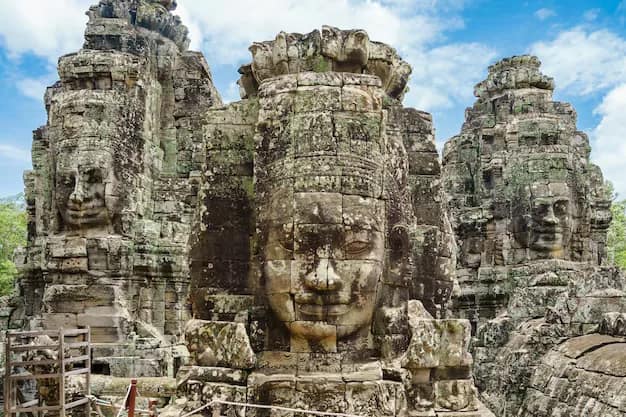
Beyond Angkor Wat itself, two temples steal the show. Bayon, at the centre of the walled city of Angkor Thom, is studded with more than 200 enormous, faintly smiling stone faces that seem to watch you from every angle, and it is best in soft mid-morning light. Ta Prohm, meanwhile, is the one Hollywood made famous — a crumbling monastery left half-swallowed by giant silk-cotton and strangler-fig roots, atmospheric and photogenic in a way no restored ruin can match. To link these you want either a tuk-tuk, which typically runs somewhere around USD 18 to 25 a day for the main loop and is the cheerful, breezy way to hop between temples, or a licensed English-speaking guide for roughly USD 40 to 55 on top, well worth it for a day if you want the history, symbolism and carvings explained rather than just wandered past. A common approach is a tuk-tuk for all three days plus a guide for the first, big-temple day. Grab a local eSIM so maps and tuk-tuk apps work the moment you land — our eSIM and international SIM guide walks through the options.
Adding Phnom Penh, the e-visa, and what it costs
Many travellers pair Siem Reap with two nights in the capital, Phnom Penh, a six-hour drive or a short domestic flight away, where the Royal Palace and Silver Pagoda sit alongside the deeply moving Tuol Sleng genocide museum and the Killing Fields — sobering but important context for modern Cambodia. On paperwork, Cambodia offers an e-visa for Indian passport holders that you apply for online before you fly through the official government portal, with the tourist e-visa fee currently in the region of USD 30 plus a small processing charge; approval usually lands by email within a few working days, so apply a couple of weeks ahead and always verify the current fee and requirements on the official site, since these change. If a visa feels fiddly, our team can handle it for you — see our Surat visa desk for a hands-off application. Budget-wise, Cambodia is gentle: outside flights, a comfortable mid-range week of hotels, passes, tuk-tuks, guides and food tends to land somewhere around ₹45,000 to ₹80,000 per person, less if you travel lean. Because it is so easy to combine, most people fold it into a bigger trip — read our Vietnam and Cambodia combined itinerary, the standalone Vietnam travel guide, and the Thailand first-timer guide from Surat, or extend the beach leg with our seven-day Bali itinerary.
Frequently asked questions
Do Indians need a visa for Cambodia?
Yes, but it is easy — Indian passport holders apply for a tourist e-visa online before travel through the official government portal, and it is usually approved by email within a few working days, so there is no embassy queue to join.
How many days do you need for Angkor?
Two to three days of temple visiting is ideal, which is why the three-day pass suits most first-timers; a single day only skims Angkor Wat, Bayon and Ta Prohm and leaves you no room for the quieter outer temples.
When is the best time to visit Cambodia?
Aim for the cool, dry November to February window for comfortable temperatures and clear sunrise skies, and avoid the fierce March to May heat and the heavy mid-year monsoon downpours where you can.
Ready to make Angkor Wat happen?
Our Surat team can package your Cambodia trip end to end — Siem Reap and Phnom Penh hotels, the Angkor passes, a trusted tuk-tuk and guide, and the e-visa sorted so you land stress-free — and slot it neatly alongside Vietnam or Thailand if you fancy a bigger loop. Message us on WhatsApp or through the contact page, or browse our tour packages from Surat to start planning.