
For many Indian travellers China sits in a strange blind spot — a giant neighbour we know from headlines and phone factories, but rarely picture as a holiday. That is a shame, because few countries pack this much wonder into a single trip: the Great Wall snaking over green ridgelines north of Beijing, an underground army of eight thousand life-size clay soldiers guarding a first emperor's tomb near Xi'an, and Shanghai's science-fiction skyline glittering across the river from colonial stone facades a century older. China is also astonishingly easy to move around thanks to the best high-speed rail network on earth, where trains gliding at over 300 kilometres an hour connect these cities in a few comfortable hours. The catch is that China rewards preparation more than almost anywhere else — the visa, the fully cashless payment system and the walled-off internet all need setting up before you fly — and this guide walks you through both the magic and the mechanics so nothing catches you out.
Beijing: the Great Wall, the Forbidden City and Tiananmen Square
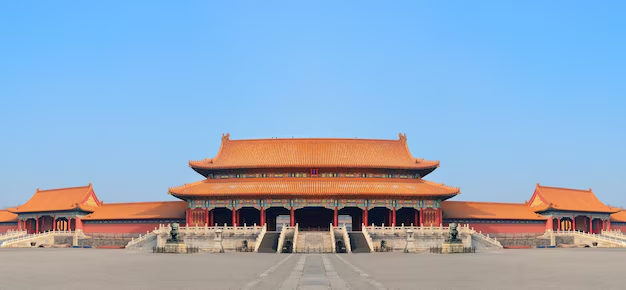
Beijing is where most China trips begin, and rightly so, because it stacks three world-famous sights within easy reach. The Great Wall is the obvious pilgrimage — most visitors head to restored sections like Mutianyu or Badaling a couple of hours from the city, where you can walk the ramparts between watchtowers and, at the quieter stretches, feel the sheer scale of a two-thousand-year-old defensive line disappearing over the horizon; go early to beat both the crowds and the haze. In the city centre the Forbidden City, the vast imperial palace complex of the Ming and Qing dynasties, takes a good half-day to cross through its endless courtyards and vermilion halls, and it opens directly onto the immense expanse of Tiananmen Square. Beijing also does temples, hutong alleyways and roast duck beautifully, so give it three full days at least. If you are weighing China against another headline Asian culture trip, our Japan travel guide for Indians makes a useful side-by-side for first-timers deciding where to spend their big trip.
Xi'an and the Terracotta Army, reached by bullet train
From Beijing the classic move is to take a high-speed train roughly four and a half to six hours southwest to Xi'an, once the eastern terminus of the Silk Road and home to the single most jaw-dropping archaeological site in China. The Terracotta Army — thousands of individually sculpted warriors, horses and chariots buried to guard the tomb of China's first emperor and only rediscovered in 1974 by farmers digging a well — is displayed in cavernous hangars where you look down on rank after silent rank of soldiers, no two faces alike. Xi'an itself is a walled city with an intact Ming-era rampart you can cycle around, a lively Muslim Quarter famous for its street food, and a Bell Tower glowing at night. The train ride there is an attraction in itself, smooth and punctual, and it is the reason a Beijing–Xi'an–Shanghai loop works so elegantly. Travellers who love this kind of efficient rail-based touring will recognise the appeal from our seven-day Japan itinerary through Tokyo, Kyoto and Osaka, which runs on the same bullet-train logic.
Shanghai's skyline and the dreamlike scenery of Guilin and Zhangjiajie
Shanghai is China at its most futuristic and cosmopolitan, and the contrast with Beijing's imperial gravity is the whole point of visiting both. The Bund is the essential first stop — a riverfront promenade of grand 1920s European banking houses on one side and, across the Huangpu River, the space-age towers of Pudong, including the bottle-opener-shaped skyscraper and the pearl-tipped TV tower, all ablaze after dark; beyond the postcard skyline the city rewards wandering through the plane-tree-lined lanes of the former French Concession, the classical Yu Garden and some of Asia's best rooftop bars, with easy day-trips to canal towns like Zhujiajiao or Suzhou. If the cities are China's history and modernity, its landscapes are pure fantasy: Guilin and the Li River in the south are the karst-mountain scenery printed on the old twenty-yuan note — jade-green pinnacles rising out of misty paddy fields, best seen on a slow cruise or a bamboo raft near Yangshuo — while further north in Hunan province Zhangjiajie is a forest of towering sandstone spires wrapped in cloud, widely credited as visual inspiration for the floating mountains of the film Avatar and now threaded with glass skywalks. These scenery regions add flying connections and a few extra days, so they suit a second visit or a fuller two-week route rather than a rushed week, which is exactly the kind of pacing our team helps you get right when you plan through our tour packages from Surat. If your itinerary might tack on a nearby city-break, note how well the region connects onward — our Hong Kong Disneyland family guide and our Seoul travel guide for Indians both pair naturally with an East Asia trip built around Shanghai.
The tourist visa, cashless payments, the VPN reality and eating vegetarian
This is the section that makes or breaks a China trip, so read it twice. Indian passport holders need a Chinese tourist visa — the L visa — which at present is applied for in person or by appointment through the Chinese Visa Application Service Center rather than online, with your itinerary, hotel bookings and return flights in hand; because the exact process, appointment system and fees are revised from time to time, treat any figure you read as indicative and confirm the current requirement before you commit, and let a visa specialist verify your file, which is precisely what our team offers through our visa desk in Surat. Two things about daily life in China surprise almost every first-timer. First, the country is effectively cashless — locals pay for everything from taxis to street snacks by scanning QR codes through Alipay or WeChat Pay, and while both apps now let foreign travellers link an international card, you should install and set them up before you fly rather than fumbling on arrival; our forex cards versus cash guide for Indian travellers helps you decide your backup money mix. Second, the internet you know is walled off: Google, Gmail, WhatsApp, Instagram and many other services are blocked, so a reputable VPN installed and tested before departure is close to essential for staying in touch, and a working data plan matters more here than anywhere — sort an international eSIM before you travel so you land connected. On food, pure-vegetarian and especially Jain eating genuinely takes effort in China, where even 'vegetable' dishes may be cooked with meat stock or share a wok; learn a few written phrases, lean on tofu, noodle and Buddhist-restaurant options, and skim our Jain and vegetarian friendly destinations abroad for tactics that travel well. Finally, spring — roughly April and May — and autumn — September and October — are the sweet-spot seasons for mild, clear weather, and packing for the range is easier if you review our international flight baggage allowance guide first.
Frequently asked questions
Do Indians need a visa for China?
Yes — Indian travellers require a Chinese tourist (L) visa arranged before travel through the visa application service centre, and because the process and fees are periodically updated, confirm the current requirement with a specialist rather than relying on old figures; our Surat visa desk can check your documents.
Will my phone and apps work in China?
Many familiar services such as Google, WhatsApp and Instagram are blocked, so install and test a trusted VPN before you fly and set up Alipay or WeChat Pay in advance, since much of daily life is cashless and runs through those apps.
Is it hard to eat vegetarian in China?
It takes planning — hidden meat stock and shared woks are common — but it is very doable if you carry written phrases, seek out tofu, noodle and Buddhist-temple restaurants, and browse our vegetarian-friendly destinations guide for practical habits before you go.
China is one of those trips that feels daunting from a distance and effortless once someone has handled the moving parts — the visa file, the rail-and-flight sequencing across Beijing, Xi'an and Shanghai, the payment and connectivity setup, and honest pricing so there are no surprises. Message the Explera Vacations team on WhatsApp or send us an enquiry and we will shape a China itinerary around your dates, your budget and your food needs, right from our office in Surat, so all you have to do is stand on the Wall and take it in.