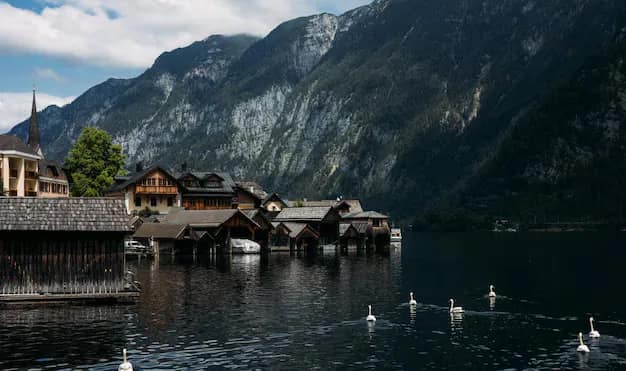
If one photograph has sold Austria to the world, it is Hallstatt — a huddle of pastel houses and a slim church spire pressed between a dark green mountainside and a glassy alpine lake in the Salzkammergut region. For travellers from Surat and the rest of Gujarat, it is usually the emotional high point of an Austria trip: small enough to walk end to end in twenty minutes, yet so scenic that most visitors fill a phone's memory before lunch. Austria sits inside the Schengen area, so you will need a Schengen visa for Austria before you travel; our visa desk in Surat handles the appointment, documentation and cover letter so the paperwork never gets in the way of the scenery. This guide covers how to reach Hallstatt, what to see, what vegetarians can actually eat, and whether a day trip or an overnight stay suits you better.
Getting there from Salzburg or Vienna, and the best time to go
There is no airport in Hallstatt, so you arrive via Salzburg (roughly 1.5 to 2.5 hours away) or Vienna (about 3.5 to 4 hours). From Salzburg, the popular route is a bus combination via Bad Ischl, or a train to Attnang-Puchheim and then the branch line to Hallstatt station, which sits across the lake — a short ferry glides you over to the village for one of Europe's great arrival moments. From Vienna, take the railjet towards Salzburg, change at Attnang-Puchheim, and connect to the same lakeside line; verify current timetables and fares on the OeBB app before you commit. May, June and September offer the best balance of green scenery, open attractions and manageable crowds, while December brings a snow-dusted postcard look; our month-by-month Europe weather guide breaks down what each season feels like. If you would rather not juggle connections, our flight booking team can plan the full India-to-Austria routing for you.
The village and that classic viewpoint
Hallstatt itself is tiny: a Market Square (Marktplatz) ringed by ivy-covered guesthouses, two small churches, a lakeside promenade and swans that pose as reliably as models. The photograph everyone travels for is taken from the Gosaumuhlstrasse viewpoint at the northern end of the village — a five-minute walk along the lake road from the square — where the church spire, the houses and the mountains stack into that one perfect frame. Go before 9 am or after 5 pm for soft light and thin crowds. Do not miss the Bone House (Beinhaus) beside St Michael's Chapel, with its centuries-old painted skulls, and remember that people live here: keep voices low in the lanes, never open private gates for a photo, and drones are restricted over the village.
Salt mine, skywalk and the lake itself
Hallstatt is not just pretty — it is one of the oldest salt-mining sites on earth, and the Salzwelten salt mine above the village claims roughly 7,000 years of history. A funicular carries you up the mountain, where guided tours walk you through tunnels, an underground salt lake and two wooden miners' slides that delight every age group; carry a light jacket, as the mine stays cold year-round. At the top station, the Skywalk 'World Heritage View' platform juts out about 360 metres above the rooftops for the best aerial view of the village and lake — free to walk onto once you are up there. Back at lake level, an electric boat cruise or the humble Hallstatt station ferry gives you the village from the water, and neighbouring Obertraun offers quieter shores, the Dachstein ice caves and the Five Fingers viewing platform for those with an extra half day. Expect the funicular-plus-mine combination to cost a mid-range attraction price by European standards; check current tickets on the official Salzwelten site rather than relying on old blogs.
Food in Hallstatt, with a note for vegetarians
Lakeside restaurants specialise in fresh-caught fish, but vegetarians from Gujarat will manage better than expected: most menus list Kasespatzle (Austrian cheese noodles, similar in comfort-food spirit to a khichdi-macaroni hybrid), Kaiserschmarrn (shredded sweet pancake), vegetable strudels, potato dishes and salads — just confirm the soup base is vegetable, not meat stock. Options are limited and kitchens close early, so a strict Jain or pure-veg group should carry theplas, khakhras and instant meals as backup, and consider self-catering apartments in Obertraun or Bad Goisern where supermarkets make cooking easy. Cafes around the Marktplatz do good coffee and apple strudel; count on a sit-down meal costing noticeably more than in Vienna, as everything is ferried into this small village.
Day trip or overnight stay — plus budget and crowd tips
Between roughly 10 am and 4 pm in summer, up to ten thousand day trippers can pour through a village of under eight hundred residents — tour buses from Salzburg, Vienna and beyond arrive in waves. The single best trick is to stay overnight: after the buses leave, you get golden-hour photographs, silent lanes and a sunrise that day trippers never see. Hallstatt hotels are few and book out months ahead, so reserve early through our hotel booking desk, or stay cheaper across the lake in Obertraun. If you only have one day, arrive before 9 am, do the salt mine first, and photograph the viewpoint late. Budget-wise, treat Hallstatt as a premium stop — accommodation and food run higher than big-city Austria — and always verify current rules, timetables and entry prices close to your travel date. Couples should note the village is a dream setting; ask about our honeymoon packages designed in Surat if this is a post-wedding trip, and pair the visit with our Salzburg travel guide or the full Austria itinerary covering Vienna, Salzburg and Hallstatt to build the complete route.
Frequently asked questions
Do Indians need a visa for Hallstatt?
Yes — Austria is a Schengen country, so you apply for a short-stay Schengen visa, usually through VFS in Ahmedabad or Mumbai for Gujarat residents. Our step-by-step Schengen visa guide from Gujarat walks through the documents, and remember that proof of travel insurance arranged in Surat with the required medical cover is mandatory for the application.
Is one day enough for Hallstatt?
A well-planned day covers the village, viewpoint and either the salt mine or a boat ride, but an overnight stay transforms the experience by giving you the village without crowds. Is Hallstatt worth it despite the tourists? Yes — arrive early or stay late and the magic is very real; if your dates are flexible, shoulder-season visits in May, June or September feel far calmer than July and August.
Ready to see Austria's most beautiful village for yourself?
Talk to our travel experts at Explera Vacations for a customised Austria plan, or browse our Europe tour packages from Surat that combine Hallstatt with Salzburg, Vienna and the Alps in one seamless, visa-supported trip.