Most Indian itineraries to Switzerland run through the German-speaking centre — Zurich, Lucerne, Interlaken, the Jungfrau. Lausanne sits somewhere else entirely, on the north shore of Lake Geneva in the French-speaking west, and travellers who make room for it usually tell us afterwards that it was the part of the trip they least expected to like most. It is a working university city rather than a postcard village, it speaks French, it drinks its own wine, and it looks south across a very wide lake at the French Alps.
Our team in Surat has been putting Lausanne into Switzerland itineraries for years, usually as the counterweight to the mountain half of the trip. This guide covers what the city actually is, the one physical fact that shapes every day you spend there, and — because we would rather say it early than let you discover it at a restaurant table — what Switzerland is going to cost you.
A city built on a slope, and why that matters
Lausanne is genuinely hilly. Not gently undulating — steep. There is roughly 500 metres of vertical between the upper town around the cathedral and the lakeside district of Ouchy, and the city has simply built itself down that slope in terraces, bridges and stairways. The metro line that connects the two is effectively a funicular in places, climbing gradients no ordinary train would attempt. Locals use it constantly and so should you.
This single fact should shape how you plan your days. Do not sketch a walking route on a flat map and assume it will take the time the map suggests. Group your sightseeing by altitude: do the old town and cathedral together while you are up high, do Ouchy and the lake promenade together while you are down low, and use the metro to move between the two rather than grinding up and down on foot. Older travellers and anyone with knee trouble will find this makes the difference between a lovely city and an exhausting one — the same principle we set out in our travel advice for taking parents and senior citizens abroad. Comfortable shoes matter here more than in almost any European city we send clients to.
The Olympic Capital
Lausanne's global identity is the Olympics. The International Olympic Committee has had its headquarters here since 1915, and the city is formally the Olympic Capital — a title it wears everywhere, from street signage to the sports federations that have clustered around the IOC over the decades.
The anchor attraction is the Olympic Museum at Ouchy, and we say this as people who are usually sceptical of single-theme museums: it is genuinely well done. The collection holds torches from every modern Games, medals, and the actual equipment athletes competed with, arranged so that the history of the movement reads as a story rather than a display case. It sits in a sculpture park stepping down towards the water, so even the approach is worth the walk. Families travel well here — children who have no particular interest in museums tend to engage with it. Check current opening days before you go, as they shift seasonally.
The cathedral and the night watchman
Lausanne Cathedral is one of the finest Gothic buildings in Switzerland, and the tradition attached to it is the detail we most enjoy telling clients. Every night, a watchman climbs the belfry and calls the hours aloud across the four sides of the tower — a practice that has continued, unbroken, for centuries. It began as a fire watch and it has simply never stopped. Standing in the square below at night and hearing a human voice announce the hour over a modern city is a strange and rather moving thing.
The tower climb is steep, and there is no lift. The reward is a view over the rooftops to the lake and across to the Alps on the French shore. Go on a clear morning if you can — afternoon haze over the water is common in summer.
The old town, and an unusually good museum district
Below the cathedral, the old town rewards slow wandering. Place de la Palud has the city's handsome fountain and a moving clock whose figures parade at the hour, and the square hosts markets that are worth timing your morning around. The Escaliers du Marché, a covered wooden stairway climbing from the square towards the cathedral, is one of those pieces of medieval engineering that survives simply because it was always useful. Down at the lake, the Ouchy promenade runs for a long, flat, welcome stretch beside the water — plane trees, boats, and the Alps opposite.
The smartest recent development for a short visit is Plateforme 10, the arts district built beside the railway station. It brings the fine arts museum, the photography museum and the design and applied arts museum together on one site, which means that a traveller with a single free morning can see three serious collections without crossing the city. Separately, and quite unlike anything else, the Collection de l'Art Brut holds an internationally significant body of outsider art — work made by people entirely outside the art world, often in institutions. It is not a comfortable museum, but it is an unforgettable one.
Lavaux: the best day out on the lake
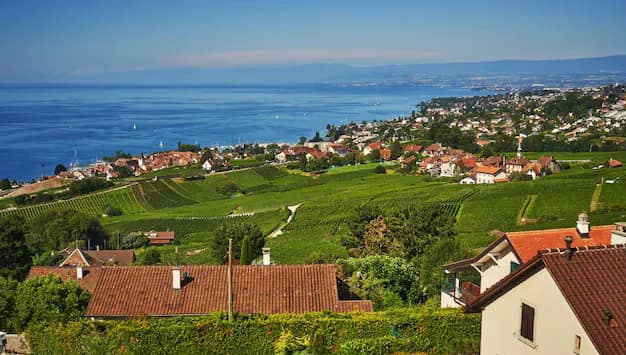
If you take one recommendation from this guide, take this one. East of Lausanne, the north shore of Lake Geneva rises in terraced vineyards that have been cultivated since the eleventh century, when monastic orders first cut the slopes into steps. The Lavaux terraces are UNESCO-listed, and walking the paths between the villages — Saint-Saphorin, Rivaz, Epesses — with the lake immediately below and the Alps standing opposite is, in our view, one of the great short walks in Europe.
The practical beauty of it is that you need no car. Regional trains stop at the villages along the shore, so you can ride out, walk a section between two stations at whatever pace suits you, stop at a village cellar, and take the train back. It scales to your energy: an hour, or a full unhurried day. September and October, at harvest, are the finest weeks, when the terraces turn and the villages are busy with the crush. This is also where you will taste the Lavaux white wines, which rarely leave Switzerland in any quantity and are a real part of the region's identity.
Around the lake: Montreux, Chillon and the boats
Lake Geneva is long, and Lausanne sits usefully in the middle of it. East along the shore is Montreux, and just beyond it Chillon Castle, a medieval fortress built on a rock at the water's edge — arguably the most photographed building in Switzerland, and genuinely worth the visit rather than just the photograph. At Corsier-sur-Vevey, between the two, Chaplin's World occupies the house where Charlie Chaplin spent the last quarter of his life, and it is a better museum than the concept suggests.
The CGN boat services criss-cross the lake, including across to Evian on the French shore, and a leg by boat instead of train is one of the cheapest pieces of theatre in the region. At the far western end sits Geneva. Do check the documentation implications before hopping over to France — the water is a border, and while both countries sit inside the Schengen area, you should still be travelling with your passport and your permissions in order, as we explain in our breakdown of which countries a Schengen visa lets Indians enter.
Getting there from India
There are no direct flights from India to Lausanne — the city has no airport of its own. Realistic routings run through a Gulf hub or a European connection, and then to one of two Swiss gateways. Geneva (GVA) is by far the closer: the airport has its own railway station and the direct train to Lausanne takes roughly forty minutes. Zurich (ZRH) works too, at roughly two and a quarter hours by train, and is sometimes the better fare, but it costs you half a day.
Here is the practical point worth internalising. Swiss trains run to the minute. A connection that would be reckless in most countries is entirely routine here, so a tight airport-to-train transfer genuinely works — and equally, a train leaves on the minute it says, not a minute later. Travellers from Gujarat will usually connect via Mumbai or Delhi, and our note on flight options out of Gujarat's airports covers how that first leg tends to shake out, while our approach to finding cheaper international fares is worth reading before you lock in dates.
Visa: Schengen, but not the EU
Switzerland is a Schengen country, so Indian passport holders need a Schengen visa. The documentation logic is the familiar one — confirmed flight bookings, confirmed accommodation for the full stay, financial evidence showing you can support the trip, employment or business proof, and mandatory medical and repatriation cover valid across the Schengen area. The file should tell a coherent story: the itinerary, the money and the ties back home should all agree with each other.
Which consulate you file with matters. As a rule you apply to the country where you will spend the most nights, or the country of first entry if the nights are evenly split — so a trip that is mostly Switzerland goes to the Swiss mission, even if you fly into Paris. We set this out properly in our guide to choosing the right Schengen country to apply through from Gujarat, and the full paperwork sequence is in our step-by-step Schengen application walkthrough for Gujarat applicants. Start roughly eight to ten weeks before departure — peak-season appointment slots vanish early. If a previous application has gone against you, our analysis of why Schengen applications get refused and how to reapply is the place to begin. The EU has also been rolling out biometric entry and exit procedures at external borders; we cover the shape of it in our explainer on Europe's biometric border system for Indian travellers, and you should verify current rules and fees before you travel, as these are still changing. We do not quote fee figures here for that reason — check the official position at the time you apply, or ask our visa documentation team in Surat to confirm it for you.
One distinction catches travellers out repeatedly: Switzerland is in Schengen but is not in the European Union, and it uses the Swiss franc, not the euro. Some places near the borders will accept euros informally, at poor rates. Plan on francs.
What it will cost, honestly
This is the most important practical paragraph in the guide. Switzerland is among the most expensive countries most Indian travellers will ever visit, and Lausanne — a prosperous lakeside city with a large international institutional population — is not a cheap corner of it. We would rather you hear that from us in Surat than discover it over a restaurant bill in Ouchy.
The money goes in three places: restaurants, hotels and drinks. A sit-down dinner for two with wine can cost a multiple of what the same meal costs in Italy or Spain. Hotel rates in the city centre and along the lake are high year-round and rise sharply in summer. Even a coffee and a soft drink add up in a way that surprises people.
The savings are real, though, if you know where they are. Buy lunch from Migros or Coop — the big supermarket chains both run food counters and bakery sections, the quality is excellent, and eating a picnic lunch on the Ouchy promenade or on a Lavaux terrace is not a compromise, it is arguably the better experience. Most Lausanne hotels give guests a free transport card covering the local network for the duration of the stay; ask for it at check-in, because it is not always offered. Tap water is excellent and free, and public fountains across the old town run drinkable water, so carry a bottle rather than buying them. On rail passes, do the arithmetic rather than assuming: the Swiss Travel Pass and the regional passes save serious money on some itineraries and lose money on others, and it depends entirely on how many long train legs you actually take. We run that calculation per itinerary for our clients. For the broader planning, our framework for budgeting an international trip from Gujarat and our guide to forex, cards and carrying money abroad both apply directly here — Switzerland is a card-first country, but keep some francs in cash.
As an indicative range only: a ten-to-fourteen day Switzerland trip from India, flights included, mid-range hotels, with rail travel and the usual mountain excursions, typically lands somewhere around ₹2,00,000 to ₹3,50,000 per person, and a comfortable or peak-season version runs higher. Treat that as a planning band, not a quotation — it moves with season, airfare, hotel standard and how many cable cars you take. What we will say plainly is that this sits at the expensive end of European travel, and budgeting for a Switzerland trip on Eastern European numbers is the single most common planning error we correct.
Season, and what to actually pack
Late spring through early autumn — roughly May to September — is the window for the lake, the terraces and the walking. September and October are the pick for Lavaux, when the vineyards turn and the harvest is in. Winter at lake level is grey and damp rather than picturesque, though the Alps are about an hour away and the skiing is very much accessible from a Lausanne base.
Pack for a lake, not a mountain. Lausanne sits at lake level and is markedly milder than the resorts, which surprises people who have packed for their idea of "Switzerland" and then spend July sweating in a fleece. Bring layers, one genuinely warm item for a day trip up into the Alps, a light rain layer, and shoes that can handle steep cobbles. Our packing checklist for international travel covers the rest, and if this is a first trip abroad, our first-timer's preparation checklist for travellers from Gujarat is the better starting point.
Everyday practicalities
Sunday closures are near-total for shops, and this genuinely catches visitors out — plan your buying on Saturday. Station shops and some tourist-area outlets are the exceptions. French is the working language, and English is widely but not universally spoken; a greeting in French opens doors that arriving in English does not. Swiss punctuality is not a stereotype, it is an operating standard, so treat departure times as literal. Get a local data connection sorted before you land — our comparison of eSIM and international SIM options for Indian travellers covers what works in Europe. And take the medical and trip cover requirement seriously: it is mandatory for the visa, and in a country where healthcare costs what Swiss healthcare costs, it is not paperwork.
Food, vegetarian and Jain
This is French-speaking Switzerland, so the cooking leans French and rich rather than German-Swiss. The two famous dishes, fondue and raclette, are both cheese-based, which is genuinely good news for vegetarians — a shared fondue pot with bread and potatoes is a proper meal and a proper evening. Two honest caveats: fondue very often contains kirsch, a cherry spirit, and some restaurants add meat or serve raclette with charcuterie, so ask before ordering. Papet vaudois is the local speciality and contains sausage, so it is not an option. Perch fillets from the lake are everywhere on menus here and are, obviously, not vegetarian.
For strict vegetarians there is a further question worth asking: much traditional Swiss cheese is made with animal rennet. Many restaurants will not know the answer, and some will. If this matters to you, it is worth deciding your position before the trip rather than at the table. Indian restaurants exist in both Lausanne and Geneva and are a reliable fallback, though at Swiss prices. A strict Jain traveller will need to plan around onion, garlic and the rennet question together, which in practice means booking accommodation with a kitchen for part of the stay, carrying some staples from home, and leaning on the Indian restaurants where they exist. It is workable, but it wants planning rather than improvisation — tell us at the enquiry stage and we build it into the itinerary.
How Lausanne fits an itinerary
We would give Lausanne two or three nights inside a ten to fourteen day Switzerland trip. Pair it with Geneva at one end of the lake and Montreux and Chillon at the other, and then move to the Alps — Zermatt for the Matterhorn, or Interlaken as a base for the Jungfrau region. That shape gives you the French-speaking lake country as a counterweight to the German-speaking mountain centre, and the two halves feel like genuinely different countries, which is much of the pleasure of travelling in Switzerland.
If you are building that route, our Lucerne city guide for Indian travellers covers the classic central stop, our Zermatt and Matterhorn planning guide handles the high-Alpine leg, and our Interlaken and Jungfrau region guide sets out the other mountain base. For a broader European trip that takes in more than one country, look at our fifteen-day multi-country Europe itinerary from India.
If you would like us to build this properly — the routing from Surat, the Schengen file for Switzerland, the hotels at the right altitude in a city where altitude decides your day, and an honest costing before you commit — talk to our team or come and see us about tour packages arranged from Surat. We will tell you what Switzerland costs before you book, not after. Please verify current visa fees, entry procedures and opening arrangements before you travel, as these change.