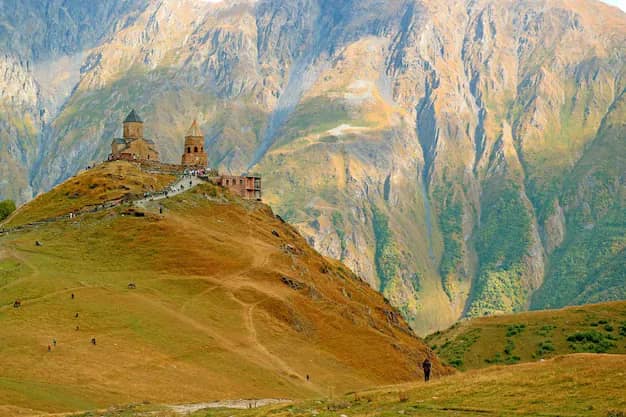
There is one photograph that has done more for Georgian tourism than any advertising campaign: a small stone church standing entirely alone on a green ridge, with a snow-covered mountain rising behind it. That is Gergeti Trinity Church, and the mountain is Kazbek. Almost every client who walks into our Surat office asking about Georgia has seen that image, usually without knowing where it was taken. This guide is about getting you there properly — and about the handful of things that go wrong when people arrive unprepared.
Where Kazbegi actually is
The town is officially called Stepantsminda, though everyone still says Kazbegi, and both names appear on signs, bus boards and booking sites. It sits at roughly 1,750 metres in the valley of the Terek river, in Georgia's Greater Caucasus, close to the Russian border. Above it stands Mount Kazbek, a dormant stratovolcano of about 5,050 metres, which on a clear morning dominates the entire skyline and on a cloudy afternoon simply does not exist.
Gergeti Trinity Church — Tsminda Sameba in Georgian — is a 14th-century stone church built on a ridge at roughly 2,170 metres above the village of Gergeti, across the river from the town. It has no village around it, no cluster of buildings, nothing to soften the outline. That isolation is the whole point of the view, and it is why the walk up matters more than most people expect.
The dress code: read this before you pack
We put this early on purpose, because it is the single most common way a Kazbegi day gets spoiled. Gergeti is not a monument. It is an active Georgian Orthodox church with a working monastic community, and the dress rules are enforced at the door. Women are expected to cover their heads and wear a skirt — wrap skirts and headscarves are usually available in a box at the entrance, but do not plan around that. Men should wear long trousers and remove hats before entering. Shorts are not acceptable for anybody, of any age or gender. Photography inside the church is often restricted, and where it is permitted, flash is not.
The practical problem is that people climb up in hiking shorts, sweating, and then find they cannot go inside the building they just spent two hours reaching. Our advice to every client: carry lightweight long trousers or a wrap in your daypack, and a scarf. It weighs nothing. For a fuller list of what belongs in the bag, our complete packing checklist for international trips covers the layering side of this properly.
Three ways up to the church, and which one suits you
There used to be one honest answer to this question. Now there are three, and we would rather explain all of them than pretend one is morally superior.
Walking is the best experience if your knees and lungs allow it. From Stepantsminda the ascent takes roughly one and a half to three hours depending on your fitness and which route you take, gaining around 400 metres. It is genuinely steep in stretches, particularly the forested section, and the surface is loose in places. Come down in about half that time. The reward is that the church appears gradually, in glimpses through pines, rather than arriving all at once through a car window.
A local 4x4 is the traditional alternative. Drivers wait in the town square, negotiate in lari, and take the rough track up. This is a completely legitimate choice, not a cop-out. Many of the older parents and grandparents we send to Georgia simply cannot manage 400 metres of steep gravel at altitude, and families with small children are in the same position. Nobody should feel apologetic about taking the jeep.
The paved road now exists, and it has changed the place. Access is far easier, which is genuinely good for people who could not previously get there — and it also means the ridge is much busier, especially at midday in July and August. If you want the church to yourself, go early. Early solves the crowds and the cloud in one move.
The Georgian Military Highway is half the trip
The drive from Tbilisi to Stepantsminda takes roughly three hours and is a genuine highlight rather than a transfer to be endured. You climb past the turquoise Zhinvali reservoir, stop at the Ananuri fortress complex on its shore, rise through the Gudauri ski area, and pass the Russia–Georgia Friendship Monument — a curved concrete arc with a mosaic interior perched over a valley that drops away spectacularly.
Be realistic about the road itself. It is a mountain highway shared with heavy freight trucks grinding towards the Russian border, with slow overtaking and stretches of roadworks. It can close in winter for snow and avalanche control, sometimes at short notice, and reopen in convoys. We do not recommend that a first-time visitor drive it themselves in winter. Take a driver who does it weekly. Marshrutka minibuses leave from Tbilisi's Didube station and are cheap and frequent; private transfers cost more but let you stop at Ananuri and the monument, which is the reason to do the drive in the first place.
The visa question — the part you must verify yourself
Georgia has historically been one of the more straightforward destinations for Indian passport holders, which is a large part of its appeal. Two mechanisms are relevant. The first is an electronic visa applied for online through the official Georgian e-visa portal. The second is a visa-free entry provision for holders of certain valid visas or residence permits issued by countries such as the United States, the United Kingdom, Schengen states and others — if you already hold one of those, you may be able to enter without a separate Georgian visa.
We are deliberately not printing fees, permitted stay durations or the qualifying-visa list here, because all three have changed more than once and any number we write today may be wrong by the time you read it. Check the official Georgian e-visa portal before you book flights, and check it again close to departure. Our team can walk you through the current position on the Georgia visa requirements page, and if you are new to how these systems differ, our explainer on how e-visas, visa-on-arrival and embassy applications actually work is worth ten minutes before you start any application.
When to go, and the Kazbek cloud problem
Summer, roughly June to September, is the main season: wildflowers on the slopes, hikeable trails, long daylight and the best odds of a clear view. Autumn brings colour to the valley and thinner crowds. Winter turns the region genuinely dramatic — Gudauri is a serious ski area with good snow — but the highway can close and daylight is short. Spring is muddy, unpredictable, and the least rewarding window unless you have a specific reason.
Now the honest part. Kazbek is frequently hidden. Cloud builds around the summit through the day, and a great many visitors go home having seen the church beautifully and the mountain not at all. Mornings give the best odds by a wide margin, which is the strongest argument for staying at least one night in Stepantsminda rather than doing a long day trip from Tbilisi. Two nights doubles your chances.
Altitude, trails and knowing where the line is
At about 2,170 metres, the church is not an altitude problem for most healthy travellers. The ascent is still steep, and mountain weather changes fast — sun to cold rain in twenty minutes is normal. Carry a windproof layer even in August.
Going beyond the church is a different proposition. Continuing up towards the Gergeti glacier or the Sabertse ridge is a serious mountain day: proper boots, real layers, food, water and an early start, ideally with a guide. And Mount Kazbek itself is a mountaineering objective, not a trek. It requires glacier equipment, roped travel, acclimatisation days and a qualified guide. We say this plainly because people do read "dormant volcano" and assume it is a long walk. It is not.
If you are travelling with parents, this is exactly the kind of trip where pacing matters more than ambition — our guide to travelling with senior citizen parents from Gujarat covers altitude, insurance and realistic day lengths. Speaking of which, take cover seriously in the mountains; the reasons are set out in our travel insurance guide for Indian travellers.
What else is within reach
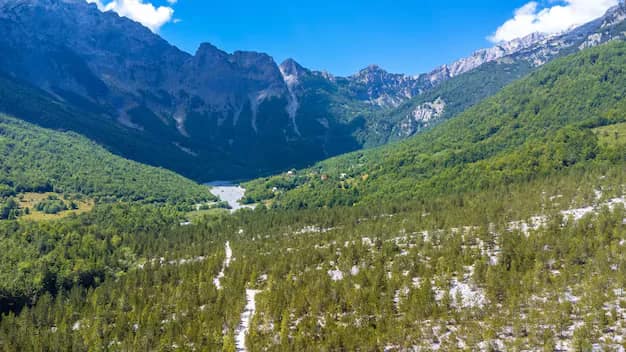
Kazbegi rewards an extra day. The Juta valley leads to the jagged Chaukhi massif, sometimes called Georgia's Dolomites, and is one of the finest short hikes in the country. The Truso valley runs west along a river past abandoned villages and mineral springs. The Gveleti waterfalls make an easy half-day. The Dariali gorge north of town is a dramatic narrow defile. And at Sno there is a strange, beautiful field of sulphur-stained mineral travertine, rust-orange against grey rock.
Beyond the mountains, Georgia has more than most visitors expect from a country of its size. Tbilisi's old town, with its wooden balconies, and the brick domes of the Abanotubani sulphur baths deserve two full days. Kakheti in the east is wine country, and Georgia has a strong claim to being one of the oldest continuous winemaking cultures anywhere, with its traditional qvevri clay-vessel method recognised by UNESCO. That is a genuinely distinctive thing to experience, whether or not you drink.
Money, connectivity and where you sleep
The currency is the Georgian lari. Cards are widely accepted in Tbilisi restaurants, hotels and shops, but in the mountains you should carry cash — guesthouses, 4x4 drivers and small cafes often prefer or require it, and ATMs in Stepantsminda are limited. Draw lari in Tbilisi before you head north. Our forex and money guide for international travel from India explains the card-versus-cash mix and how to avoid the usual conversion losses.
Mobile coverage in Stepantsminda town is generally good; on the trails and in the side valleys it becomes patchy and then vanishes. An eSIM for international travel is the simplest option here and saves you hunting for a shop on arrival. Accommodation in Kazbegi is mostly guesthouses — family-run, warm, often with excellent home cooking — plus a small number of hotels. In July and August the good ones book out well in advance. Book early rather than arriving hopeful.
Eating well as a vegetarian
Georgia is unusually kind to vegetarian travellers, and we say that from repeated client feedback rather than from a brochure. Khachapuri, the cheese-filled bread, comes in regional variations and is everywhere. Badrijani is aubergine rolled around a walnut and garlic paste. Lobio is a slow-cooked bean stew, often served with cornbread. Pkhali are small pâtés of spinach, beetroot or other vegetables bound with ground walnut. Mushroom dishes cooked in clay, fried potatoes with herbs, fresh tomato and cucumber salads with walnut dressing — a vegetarian eats extremely well here.
Two caveats, stated honestly. Khinkali, the famous soup dumplings, are usually meat-filled; potato and mushroom versions exist but are not the default, so ask. And a strict Jain traveller will still need conversations, because garlic and onion are foundational to Georgian cooking, and walnut pastes almost always contain garlic. It is workable — plain breads, rice, potato and vegetable dishes prepared to order, and guesthouse kitchens are generally willing when asked in advance — but it needs planning rather than optimism. We brief guesthouses ahead of arrival for clients who need this.
What it costs, roughly
Georgia is genuinely good value compared with Western Europe — not backpacker-cheap, but your money goes noticeably further on food, guesthouses, drivers and entry fees. As a very rough, indicative figure for a 7–9 day trip from Gujarat, we usually tell clients to plan for somewhere around ₹85,000 to ₹1,60,000 per person all-in, covering flights, accommodation, transfers, most meals and sightseeing. The spread is wide for real reasons: peak-summer airfares behave very differently from shoulder season, guesthouses and city hotels sit at opposite ends of the range, and private drivers cost several times what marshrutkas do.
Treat that as a planning bracket, not a quote. Flights are the most volatile component, and our notes on booking cheaper international flights from India and on which international routes run from Gujarat's airports will tell you more about where the savings actually sit. For the full exercise of costing a trip properly, see our budget planning walkthrough for international trips from Gujarat.
A sensible shape for the trip
Seven to nine days works well. Two or three nights in Tbilisi to start, including the old town, the sulphur baths and a day trip to Mtskheta. Then two nights in Kazbegi via the Military Highway, with the Ananuri and Friendship Monument stops built into the drive. Then two nights in Kakheti for the wine country. If you have the extra days, add Kutaisi in the west for the Prometheus and Sataplia caves and the canyons nearby.
From India, Georgia pairs naturally with a stopover. Routings through Istanbul or a Gulf hub are common, and adding two or three days at either end turns one holiday into two. Our Istanbul city guide for Indian travellers and our Dubai stopover guide both cover how to do that without adding much to the fare.
One geopolitical note, briefly
Stated neutrally and without drama: Georgia has two regions, Abkhazia and South Ossetia, that are outside central government control. Travellers should not attempt to enter them, and doing so from the Russian side can create legal problems for later entry to Georgia. Separately, the road north from Kazbegi leads to a border crossing into Russia; it is a working freight and transit route, not a casual tourist excursion. Stepantsminda itself, Gergeti, Juta, Truso and the whole Military Highway corridor are ordinary, well-visited tourist areas. Check your government's current travel advice before you book, as you would anywhere.
Let us put it together for you
Georgia is a country we enjoy planning, because it delivers far more than clients expect and rarely disappoints on value. The details that matter — a morning slot at Gergeti before the crowds and the cloud, a driver who knows the Military Highway in every season, a guesthouse in Stepantsminda that will cook to your dietary requirements, and a visa route confirmed against current official rules rather than last year's blog posts — are exactly the things our team in Surat handles day to day. Tell us your dates and who is travelling, and we will build the itinerary around your pace rather than a template. Speak to our travel team about a Georgia itinerary, or come and see us about flight booking from Surat if you would like to start with the routing and work outwards. Rules and conditions change, so please verify current visa and entry requirements before you travel.