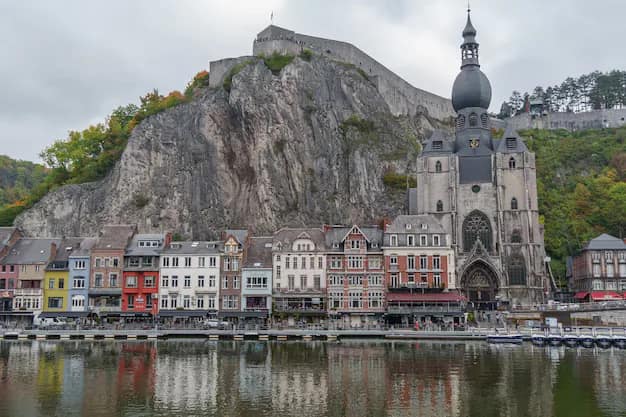
Some places take a week to understand. Dinant takes about four hours, and we would rather tell you that upfront than have you build a holiday around it and feel short-changed. What Dinant does have is one of the most photogenic settings in Belgium: a single ribbon of town pressed between the river Meuse and a wall of grey limestone, with an onion-domed church at the bottom and a citadel staring down from the top. It is roughly 90 km south of Brussels, in French-speaking Wallonia, and it is one of the easiest and most rewarding day trips in the country.
Our team in Surat sends a steady stream of travellers to Belgium every year, and Dinant is the stop that people come back talking about, usually because nobody had told them it existed. This is our honest guide to what it is, how to reach it from Gujarat, and where it belongs in a wider Europe itinerary.
The setting is the whole point
Dinant works because geography did something dramatic here. The Meuse cut a gorge through limestone, and the town had nowhere to expand but along a narrow strip of riverbank. The result is a place that is essentially one street deep in places, backed by a sheer cliff face. At the base of that cliff sits the Collegiate Church of Notre-Dame, a Gothic building topped by a bulbous, pear-shaped bell tower that looks like nothing else in Belgium. Directly above and behind it, clinging to the rock, is the citadel.
You reach the citadel one of two ways: by climbing 408 steps carved into the rock, or by cable car. The steps are steep, uneven and largely unshaded, and on a warm July afternoon they are genuinely hard work. The cable car is the sensible option for older parents, for anyone with knee trouble, and for families with small children, but check that it is running before you plan around it, as maintenance and seasonal schedules do affect it. Once you are up there, you get the shot everyone comes for: the dome of the church directly below you, the river curling away, and rooftops squeezed against the rock. The citadel itself has fortification tunnels, cannon, and displays covering its military history. Allow an hour or so up top.
Adolphe Sax, and why the town is full of saxophones
Adolphe Sax was born in Dinant in 1814, the son of an instrument maker, and he went on to invent the saxophone in the 1840s. He was a restless, quarrelsome, extraordinarily inventive man who spent much of his career in Paris fighting patent battles, and who could not have imagined that his instrument would end up defining jazz a century later. Dinant has decided, entirely reasonably, that this is the best story it has, and leans into it without embarrassment.
Walk across the Charles de Gaulle bridge and you pass a row of oversized saxophones, each painted in the colours and motifs of a different country, standing along the parapet like a small United Nations of brass. There is a modest museum at his birthplace on the main street, more a well-presented set of rooms than a grand institution, but worth the twenty minutes. A statue of Sax sits on a bench nearby, and half the town's shop windows carry a saxophone somewhere. It should be kitsch and somehow it is not. It gives a small town a genuine identity, and it makes the walk along the riverfront more interesting than it would otherwise be.
A harder layer of history
There is a sombre reason the town looks newer than its history suggests. In August 1914, during the German advance through Belgium, several hundred civilians in Dinant were executed and much of the town was burned. It was damaged again during the Second World War. What you walk through today is substantially rebuilt, and there are memorials in the town that mark what happened. We mention it not to weigh down a pleasant day out, but because visitors often notice that the architecture does not match the age of the place and wonder why. Knowing the reason changes how you look at the streets.
What else to do once you have climbed the cliff
The citadel and the church take a morning. If you want a full day, the Meuse valley obliges. River cruises run from the quayside in season, typically short loops upstream and down, and they are the laziest way to appreciate the gorge. Just south of the town centre stands the Rocher Bayard, a startlingly thin needle of limestone split away from the cliff, with the road passing straight through the gap; local legend credits a magic horse, and it is worth the ten-minute walk to see.
The classic local activity, though, is kayaking on the Lesse. You take a short transfer upriver and paddle back down to Anseremme, just outside Dinant, through wooded valley and a few small rapids. It is a half-day, it does not require any real skill, and in high summer it is what half of Belgium seems to be doing. The season is weather and water-level dependent, so it runs roughly from spring to early autumn only. Nearby you also have the Grotte la Merveilleuse caves, cool and dripping and a reliable wet-weather option, and Freÿr Castle a few kilometres downstream, an elegant riverside chateau with formal French gardens that reward a slow hour. Cyclists should know about the RAVeL greenway network, which follows the river on old towpaths and rail beds and makes for flat, traffic-free riding.
Widen the lens and Dinant sits inside the Ardennes, a region of forest, rivers and small stone towns that most Indian itineraries skip entirely. Namur, the regional capital, is 30 minutes north and has its own citadel and a far livelier evening scene. If you have the appetite for slower travel, our Europe itinerary planning for first-time travellers from India covers how to build in this kind of unhurried day without gutting the rest of your trip.
Getting there from Gujarat
There are no direct flights from India to Belgium, so every routing involves a connection. The most common shape from Ahmedabad or Mumbai is a Gulf hub, with a change in Dubai, Abu Dhabi, Doha or Kuwait onward to Brussels (BRU). Alternatively you can connect through a European hub such as Frankfurt, Zurich, Istanbul or Amsterdam. Total journey time is usually somewhere in the twelve to eighteen hour range depending on layover length. Charleroi is Belgium's secondary airport and mostly serves low-cost European carriers, so it matters more if you are hopping in from elsewhere in Europe than as an arrival point from India. Amsterdam, Paris and Cologne are all viable alternative entry points, since all three connect to Brussels by fast train in a couple of hours or less.
Travellers starting from Surat or Vadodara will usually position to Ahmedabad or Mumbai first, and our note on flying internationally out of Gujarat's airports explains how those connections realistically stack up. For fare timing, the habits in our guide to booking cheaper international flights from India apply here as much as anywhere: book the long-haul early, and stay flexible about which Gulf hub you route through.
Once you land, forget about renting a car. Dinant is the terminus of a direct rail line from Brussels via Namur, and the journey runs somewhere in the region of ninety minutes to two hours depending on the service. Trains are frequent enough that you can decide on the morning itself. Dinant's station is a five-minute walk from the church and the riverfront, so there is no onward transfer to arrange. This is precisely the kind of trip Belgian rail is built for, and it is why we usually recommend basing yourself in Brussels or Namur and coming out for the day rather than hauling luggage down.
Visas and entry formalities
Belgium is a Schengen state, so Indian passport holders need a Schengen visa. The documentation logic is consistent across all Schengen consulates: confirmed return flight bookings, confirmed accommodation for every night, bank statements and ITRs showing you can fund the trip, employment or business proof, and travel medical insurance meeting the mandatory Schengen minimum cover. Our Belgium visa requirements and application process page sets out the current document list, and the broader Schengen visa application walkthrough for Gujarat applicants explains how appointments, biometrics and processing actually work in practice.
One rule catches people out. You apply to the country where you will spend the most nights; if nights are equal, you apply to your country of first entry. So a trip that is four nights in Brussels and two in Amsterdam is a Belgium application, not a Netherlands one. If your route is more balanced, the comparison in our choosing which Schengen consulate to apply through piece is worth reading before you book anything. Start the process roughly eight to ten weeks before departure, as summer appointment slots in Gujarat and Mumbai fill up early. If you have been refused before, understanding Schengen refusal grounds and how to reapply will save you repeating the same mistake.
The EU has been rolling out biometric entry and exit procedures at external Schengen borders, which means fingerprint and facial capture on arrival and departure rather than a simple passport stamp. Expect slightly longer queues on your first entry. We keep what the EU entry-exit border system means for Indian passengers updated, but rules in this area are still changing, so verify current requirements before you travel.
When to go, and the weather truth
Late spring to early autumn, roughly May through September, is the window. That is when the cable car, the river cruises and the Lesse kayaking are all reliably operating, when the terraces along the quay are open, and when daylight stretches late enough to do the citadel and still have an evening. October brings genuinely beautiful autumn colour through the Meuse valley, and the crowds thin considerably; it is our quiet favourite if you do not care about the water activities.
Winter is honest work. It is grey, wet, dark by late afternoon, and several attractions run reduced hours or shut entirely. Dinant does not have the Christmas-market pull of Bruges or Brussels to compensate. And we should say plainly that Belgian weather is unreliable in every season, including July. Do not build a day here around clear skies. Have the caves, the Sax museum and a long lunch in your back pocket as the wet-weather plan, and you will be fine.
Money, language and practical friction
Belgium uses the euro, and cards are accepted almost everywhere, including small cafes. Carry a modest amount of cash for markets or a boat ticket, but you will not need much. Be prepared for the price level: Belgium is expensive compared with Central and Eastern Europe, and considerably more so than travellers expect after a trip to Prague or Budapest. Our forex, cards and money handling for international trips from India note covers how to carry funds without bleeding on conversion charges.
The language point matters more than people realise. Dinant is in Wallonia, so the working language is French, not Dutch. If you have been in Bruges, Ghent or Antwerp, everything switches at the linguistic border, and locals will not appreciate being addressed in Dutch. English is widely spoken in Brussels and reasonably common in Dinant's tourist businesses, but it is not universal in smaller Wallonian towns. A polite bonjour and merci go a long way. Also plan around closures: Sundays and public holidays in Belgium are quieter than most Indian visitors expect, with many shops shut and reduced transport.
On accessibility, be realistic. The old lanes are cobbled and steep, the 408 steps are exactly what they sound like, and wheeled luggage is miserable here, which is another argument for day-tripping. If you are travelling with parents, our planning European travel with senior citizen parents from Gujarat guide covers pacing, and for Dinant specifically the answer is simple: use the cable car, skip the tunnels if stairs are a problem, and enjoy the riverside instead.
Food, including for vegetarians and Jain travellers
Wallonian cooking is meat-forward, and we will not pretend otherwise. But Dinant has two specialities worth seeking out. The couque de Dinant is a biscuit of nothing but honey and flour, pressed into carved wooden moulds and baked rock hard. It is a genuine warning, not a joke: you are meant to suck it or break it into shards, never bite it, and dentists in Dinant do reasonable business from people who ignore that. Buy one as a souvenir and eat it slowly. The flamiche dinantaise is far friendlier, a hot savoury tart of local cheese, butter and eggs, served straight from the oven, and it is vegetarian.
Beyond that you have Belgium's national strengths: proper frites with mayonnaise, waffles, chocolate, and one of the best beer cultures in the world if that interests you. Vegetarian food is findable in Dinant but not abundant; expect cheese tarts, omelettes, salads, pasta and frites rather than a dedicated vegetarian menu. Brussels is a different story and has good Indian and vegetarian restaurants, so a strict vegetarian is better off eating well at base and treating Dinant as a light lunch stop. For Jain travellers, plan around onion and garlic being standard in almost everything savoury here, carry ready-to-eat packets from home, and let us brief you on which Brussels restaurants can actually accommodate a request. It is workable with preparation and frustrating without.
Budget and where Dinant fits in an itinerary
As an indicative figure, a well-organised seven to ten day Belgium trip from Gujarat, covering return flights, mid-range hotels, rail travel, entry tickets, food and insurance, tends to land in the range of roughly ₹1,60,000 to ₹2,60,000 per person. Peak summer, festival dates and last-minute flight bookings push you towards and beyond the upper end; shoulder season with early booking sits comfortably at the lower end. Dinant itself adds very little beyond a train ticket and a couple of entry fees. Treat these as planning ranges only, since airfares move constantly, and our how to budget an international trip from Gujarat piece explains how we build a realistic estimate for a specific set of dates.
Itinerary-wise, the natural shape is Brussels as your base, then Bruges, Ghent and Antwerp for the Flemish side, with one Wallonian day covering Namur in the morning and Dinant in the afternoon, or the reverse. That gives you a genuinely varied week rather than four versions of the same canal photograph. Because Brussels is two hours or less from Paris, Amsterdam and Cologne by fast train, Dinant also bolts painlessly onto a wider route; our fifteen day multi-country Europe route from India shows how that stitches together, and the list of countries you can enter on a single Schengen visa is useful before you fix the map.
Two last housekeeping items. Schengen requires medical cover as a condition of entry, so read our travel insurance essentials for Indian travellers and buy a policy that actually meets the threshold rather than the cheapest one available. And staying connected in Europe is cheap and simple now, with the options in our eSIM and international connectivity choices for Indian travellers covering what to arrange before you fly.
Let us plan it properly
Dinant is a half-day town with a full-day setting, and treated as such it is one of the nicest surprises in Belgium. Treated as a destination in its own right, it will disappoint you by teatime. That is the kind of judgement we are here to make on your behalf. Explera Vacations is IATA TIDS accredited and works with travellers across Surat, Ahmedabad, Vadodara and the rest of Gujarat on exactly these decisions: which base city, which day trips earn their place, how the visa file should be assembled, and how the flights and rail fit together. Talk to us through our contact page for trip planning enquiries, or come to us for international flight bookings handled from our Surat office and we will build the whole route around the days you actually have.