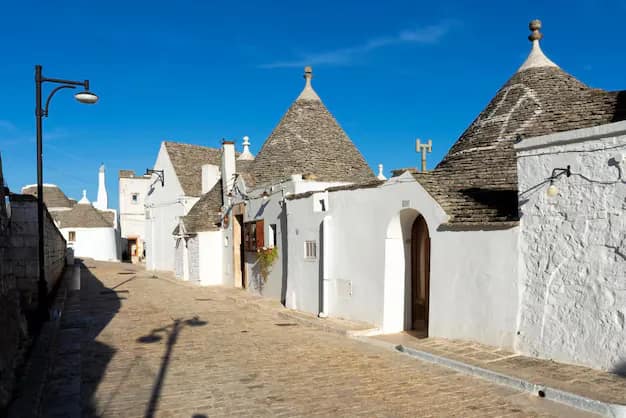
Some places in Europe photograph so well that the picture does most of the travelling for you. Alberobello is one of them: a thousand whitewashed cottages with grey conical roofs stacked up a hillside in the heel of Italy, looking less like a town than something a child built and forgot to take apart. It is UNESCO-listed, unlike anywhere else in the Mediterranean, and very easy to be disappointed by if you arrive at midday in July without a plan.
We send a steady stream of clients from Surat, Ahmedabad and Vadodara to southern Italy, and Puglia has become one of our favourite suggestions for travellers who have already done Rome, Florence and Venice. It simply needs planning differently. Here is what the trulli are, what Alberobello is really like on the ground, and why the region around it matters more than the town itself.
What a trullo actually is, and the story about the tax
A trullo is a small drystone building with a corbelled conical roof. The walls are thick limestone, lime-washed white; the roof is grey stone slabs laid in overlapping rings, each slightly narrower than the last, until the circle closes. The critical detail is that it was traditionally built without mortar. Nothing glues it together. It stands on geometry and weight alone, and has done for centuries.
Why build like this? The Murgia plateau is karst limestone and the fields are full of stone. Clearing land for cultivation produced enormous quantities of it, and building shelters and walls from that stone solved two problems at once. Trulli began as rural structures, not a town style, which is why you still see them standing singly in olive groves across the Valle d'Itria.
Then there is the story every guide tells. The traditional account holds that under Kingdom of Naples rule, landowners encouraged mortarless building so roofs could be dismantled quickly when a royal inspection or a tax on permanent settlements loomed. It is a wonderful story, and historians treat it with caution rather than as settled fact. Enjoy it as tradition, not documented history.
Look up as you walk. Some roofs carry symbols painted in whitewash, a mixture of Christian, older pagan and frankly magical marks meant to protect the household, and almost every cone is topped by a carved pinnacle stone that local lore reads as the builder's signature.
Two districts, two completely different moods
Alberobello's historic core splits into two zones that do not feel remotely alike. Rione Monti is the postcard one: roughly a thousand trulli packed down a sloping grid of lanes, dense, dramatic and almost entirely commercial, nearly every ground floor selling ceramic whistles, olive wood and fridge magnets. Across the small valley, Aia Piccola is quieter, with around four hundred trulli, few shops, laundry on lines, residents and cats. It gives a far better sense of what living in one of these buildings means, and takes twenty minutes to walk.
The honest verdict: visit Alberobello, stay in the Valle d'Itria
Here is what our team in Surat says on the phone that clients do not always expect. Alberobello's centre is small and receives very large numbers of day visitors, including coach groups circuiting out of Bari and the coastal resorts. In high season, Rione Monti between roughly ten and five is essentially a souvenir corridor with a crowd moving through it. That is not snobbery; it is what the place has become.
Two fixes work. The first is timing: arrive before nine, or stay a night and walk the lanes at dusk once the coaches have gone. The second is the one we actually recommend: treat Alberobello as a two-hour stop and base yourself in the surrounding Valle d'Itria, a shallow bowl of drystone walls, olive groves and scattered trulli ringed by towns that are lived in rather than staged.
Locorotondo is a circular hilltop town of gabled white houses, one of the prettiest in the south. Cisternino is smaller and unfussy, with a genuinely local evening passeggiata. Martina Franca is bigger, baroque, with a real weekday life. Ostuni sits further east on its own hill. Recommending the region over the single famous town is not a dodge; it is the difference between a good trip and a photograph you already had.
Sleeping in a trullo: charming, and smaller than the photographs
Many trulli are now guesthouses and holiday rentals, and a night or two in one is a real experience. The thick stone walls hold temperature remarkably well, so they stay cool through a Puglian afternoon, and waking up inside a cone of stacked stone is memorable in a way a hotel room is not.
Be realistic about the trade-offs. Rooms are often small and dim, with light coming through deep window recesses. Stairs to a mezzanine sleeping level can be tight and steep, sometimes a narrow spiral. Ventilation is limited by design, and some older conversions feel damp in winter. Our usual advice is one or two nights in a trullo for the experience, then a masseria or a normal hotel, especially with parents or small children along.
Beyond the trulli: Ostuni, Matera, the coast and Lecce
Ostuni, the white city, is a tumble of lime-washed houses on a hill above the olive plain, beautiful in late light. Just over the regional border in Basilicata, Matera combines easily: a whole town of sassi, cave dwellings carved into a ravine, inhabited for millennia, abandoned in poverty in the twentieth century and now restored. It deserves an overnight. On the Adriatic, Polignano a Mare sits dramatically on a cliff above a cove and is correspondingly busy; Monopoli next door is a working port with a better balance of life to tourism. Further south, Lecce is the baroque capital, its golden stone carved into almost ridiculous exuberance.
One thing to prepare you for. Driving through the Salento you will pass groves of dead, skeletal olive trees, some centuries old. This is Xylella fastidiosa, a bacterial pathogen identified in the region in 2013, which has killed millions of olive trees across southern Puglia and reshaped both the landscape and the local economy. Travellers usually assume drought or neglect. It is neither, and knowing what you are looking at turns confusion into respect.
Getting there from Gujarat, and why you will need a car
There are no direct flights from India to Puglia. Realistic routings run via a Gulf hub such as Dubai, Abu Dhabi or Doha, or a European hub, into Bari (BRI) or Brindisi (BDS). Alternatively fly into Rome or Milan and continue by short domestic flight or high-speed train south, which suits a trip combining Puglia with the north. Weigh the current international connections from Gujarat's airports against Mumbai and Delhi departures, and apply our notes on keeping long-haul airfares under control to summer Europe pricing.
Then, the car. We will say this plainly: the Valle d'Itria genuinely needs a rental car to be enjoyed. The regional Ferrovie del Sud Est trains link some towns, but services are slow and infrequent and go nowhere near the countryside where the masserie and scattered trulli are. This is one of the parts of Italy where public transport alone is frustrating rather than merely inconvenient. Two things matter for Indian licence holders: you must carry an International Driving Permit alongside your Indian licence, and you must understand ZTL zones, the camera-enforced limited-traffic areas in historic centres that issue automatic fines arriving months later via the rental company. Park outside the walls and walk in.
Visa, paperwork and timelines
Italy is a Schengen state, so Indian passport holders need a Schengen visa. The documentation logic is consistent: confirmed flight reservations, accommodation covering every night, financial evidence such as bank statements and tax returns, employment or business proof, and travel medical insurance meeting Schengen requirements. A Puglia trip is often several small rentals, so keep the accommodation chain complete with no unexplained gaps. Our step-by-step walkthrough of the Schengen process for Gujarat applicants covers file structure, and the common grounds for refusal and how to reapply is better read before you submit than after.
File with the consulate responsible for your main destination, which for a Puglia trip means Italy; our Italy visa desk handles appointments and file preparation. Start roughly eight to ten weeks out, earlier in the April to July rush. Fees and biometric requirements change, and the EU has been phasing in biometric entry and exit checks at Schengen borders, so verify current rules before you travel. Check that your policy satisfies the medical cover condition; our guide to choosing travel insurance for Europe explains what the wording must say.
When to go, and the small things that catch people out
May to June and September to October are the sweet spots: warm rather than punishing, crowds manageable, and in autumn the atmosphere of the olive and grape harvest. July and August are genuinely hot in the Puglian interior, well away from any sea breeze, and busy with Italian domestic holidaymakers. Around mid-August, Ferragosto brings widespread closures even in small towns. Winter is peaceful and cheap, but many rural properties and restaurants close for the season.
A few practicalities. Alberobello and Ostuni are cobbled, stepped and steep, awkward for wheeled suitcases, prams and limited mobility, so pack light and choose accommodation you can reach without hauling bags uphill; if parents are joining, see our advice on travelling with senior citizens from Gujarat. Long lunch closures, roughly one to four, surprise almost everyone. The currency is the euro and cards are widely accepted, but small towns and rural producers sometimes prefer cash, so read our practical forex and card guide for Indian travellers and carry a float. Rural coverage is patchy enough that offline maps matter, and arranging an eSIM before you fly beats hunting for a SIM at Bari airport.
Eating in Puglia when you do not eat meat
This is where Puglia becomes genuinely exciting for Gujarati travellers. It is one of the best regions in Italy for vegetarians, not by accident but because the traditional cucina povera of the south was largely plant-based. Orecchiette, the little ear-shaped pasta, comes with cime di rapa, slightly bitter turnip tops, in a dish that is entirely vegetarian and entirely local. Burrata comes from Andria, right here in Puglia. Add focaccia barese heavy with tomato and olive, fava bean purée with wild chicory, grilled vegetables, extraordinary tomatoes, superb olive oil and very good bread. A vegetarian eats extremely well here and does not spend the trip negotiating.
Two caveats, offered as information rather than advice. A strict Jain traveller must still navigate onion and garlic, foundational to almost every savoury preparation, so speak to kitchens in advance and expect grilled vegetables, plain pasta with oil, bread and salads as the reliable base. And Italian cheeses, including some mozzarella and most aged varieties, are frequently made with animal rennet. If that matters, ask specifically and carry a written note in Italian, which we prepare for clients.
What it costs, and a sensible shape for 7 to 10 days
Indicative only and heavily season-dependent, but an eight to ten day Puglia trip from India, including return flights, a rental car, mid-range accommodation and normal eating out, tends to land at roughly ₹1,80,000 to ₹2,80,000 per person. Shoulder-season dates, a shared car and early booking can bring that towards ₹1,40,000 to ₹1,80,000; boutique masserie and peak August push it past ₹3,00,000. Puglia is generally better value than Tuscany or the Amalfi Coast for comparable quality. Our framework for budgeting an overseas holiday from Gujarat sets out how we build these estimates.
The shape we most often recommend: fly into Bari for a night, then three nights in the Valle d'Itria at Locorotondo, Cisternino or a countryside masseria, using it for Alberobello early in the morning, Martina Franca, Ostuni and the coast at Polignano a Mare and Monopoli. Add one or two nights in Matera, then Lecce for two nights and the Salento coast, flying home from Brindisi. Ten days lets it breathe; seven works if you drop either Matera or Lecce rather than compressing both. It also slots in as the second week of a wider Italy trip, and our 15-day multi-country Europe itinerary from India shows how a southern leg fits a longer routing.
If this sounds like your kind of Italy, we are glad to build it properly, which here mostly means getting the base towns, the driving legs and the visa file right rather than adding more stops. Explera Vacations is IATA TIDS accredited, and our consultants handle the Schengen application, flights, car and accommodation chain together so nothing in the file contradicts itself. Come and talk to our travel team about dates, or see how we structure curated tour packages departing from Surat. Rules, fees and border procedures change, so please verify current requirements with us close to departure.