Almost every traveller who asks us about Bolivia has seen the same photograph: a person standing on a sheet of water so still that the sky is doubled, horizon dissolved, no way to tell up from down. That image is real. It is also seasonal, weather-dependent and, on a good number of days each year, simply not there. Salar de Uyuni is one of the few destinations where getting the planning right matters more than getting the booking right, and where a beautifully priced package can still end in disappointment because nobody explained what month does to the landscape.
So this is the conversation we have with clients in our Surat office before anyone pays a deposit. What the Salar actually is, the two completely different faces it wears, the altitude problem that most people underestimate, what the journey from India genuinely involves, and how to build a trip that justifies flying halfway around the planet.
What the Salar de Uyuni actually is
The Salar sits on the Bolivian Altiplano and covers roughly 10,500 square kilometres, which makes it the largest salt flat in the world. It is the floor of a prehistoric lake. Over tens of thousands of years a series of ancient lakes filled this basin and evaporated, and what they left behind is a crust of salt several metres thick, sitting on top of a saturated brine. It is not a desert of sand dusted with salt. It is salt, layered and solid, flat enough that satellites use it to calibrate their instruments.
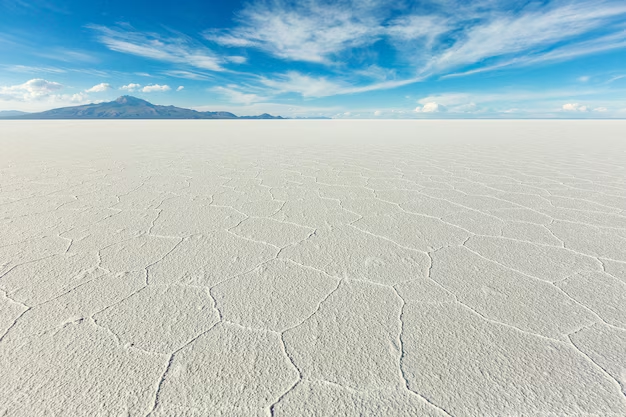
The famous hexagonal pattern you see in photographs is not decorative. As the surface dries, the crust contracts and cracks, and the cracks organise themselves into rough polygons, each ridged where salt has pushed up along the seam. Walk out onto it in the dry months and the tiling runs to the horizon in every direction, which is exactly why the place plays such tricks with scale and perspective.
There is a second, less romantic fact worth knowing. The brine below the crust holds one of the largest lithium reserves on earth. That single geological accident shapes Bolivian politics, foreign investment, local employment and a long-running national argument about who benefits from extraction. You will see evaporation ponds and industrial infrastructure at the southern edges. Understanding that context makes the visit more interesting, not less.
The season decision — and it is a real decision
This is the single most important choice you will make, and it cannot be fudged. The Salar has two seasons that produce two entirely different experiences, and you cannot have both on the same day.
In the dry season, roughly May to October, the surface is hard, white and cracked into hexagons. Vehicles drive far out onto the flat. You can reach Isla Incahuasi, the rocky outcrop studded with enormous columnar cacti that sits like an island in the middle of the salt. This is when the forced-perspective photographs work — the ones where somebody appears to be stepping out of a shoe or being chased by a toy dinosaur. The trade-off is cold. Nights on the Altiplano in these months drop hard below freezing, and multi-day tours sleep at altitude.
In the wet season, roughly December to April, rain leaves a shallow film of water across parts of the flat, and that film becomes the mirror. It is genuinely extraordinary. But say the rest of it out loud before you book: with water on the surface, vehicles cannot go as far out; Incahuasi is frequently unreachable; some itineraries get shortened; and heavy rain can close sections of the Salar entirely for days. The mirror is also not guaranteed on any given day — too little water and you get mud, too much and it stops reflecting cleanly.
The shoulder weeks either side of the transition sometimes give you patches of both, a dry driveable area alongside a flooded reflective one. Sometimes. We have seen it work beautifully and we have seen it deliver neither. If your heart is set on the mirror, go in the wet months and accept the constraints. If you want the hexagons, Incahuasi and the full multi-day route south, go in the dry months and accept that you will not get the reflection. The travellers who come back unhappy are almost always the ones who went in one season expecting the other.
Altitude: the part people take too lightly
Uyuni town sits at roughly 3,650 metres. The three-day circuit climbs considerably higher, crossing terrain above 4,500 metres in the Eduardo Avaroa reserve. La Paz, the usual gateway, is around 3,600 metres, and El Alto airport, where you land, is higher still. If you fly in from sea level you can go from Mumbai humidity to serious altitude in a single travel sequence.
Altitude sickness presents as headache, nausea, breathlessness on mild exertion, loss of appetite and genuinely poor sleep. It is not a fitness test. Marathon runners in their twenties get it while their less athletic parents feel fine. There is no way to predict who it will hit, and the only reliable responses are ascending slowly, resting, and descending if symptoms get worse rather than better. Coca tea and local remedies are offered everywhere and many travellers find them soothing, but they are not a substitute for acclimatisation and should not be treated as one.
Our standing advice is to build in two to three days at altitude — in La Paz, or better still somewhere around Lake Titicaca — before you start the Uyuni tour. Take it slowly on the first day, drink plenty of water, eat lightly, skip alcohol. If you have any heart or lung condition, if you are pregnant, or if you take regular medication, speak to your doctor before you book, not after. We will not recommend specific medicines or doses — that conversation belongs with a physician who knows your history. Ask them well in advance, because some preventive approaches need to start before you travel.
Getting there from Gujarat
There is no gentle way to say this: Bolivia is a long way from India. There are no direct flights, and no realistic single-connection routing. You are looking at two or three connections, typically via a European hub such as Madrid, Paris or Amsterdam, or via a US hub, landing at La Paz (LPB) or Santa Cruz (VVI). From there you take a domestic flight or an overnight bus onward to Uyuni. Door to door, plan for well over thirty hours each way including layovers.
One point that catches people out: a routing through the United States requires a US transit visa for Indian passport holders. Transit is not exempt. That means an application, an appointment, a fee and a timeline that can stretch considerably depending on appointment availability. Many travellers only discover this after they have booked a cheap US-hub fare. Check first whether a European routing avoids it entirely — often it does, and often the total cost works out similar once the visa is priced in. Our flight booking desk in Surat routinely runs both options side by side before recommending one.
Because the flight is long and expensive, how you build the rest of the trip matters. It is also worth reading up on smart fare hunting strategies for Indian departures and on which long-haul connections work from Gujarat's own airports, since starting from Ahmedabad or Surat rather than Mumbai changes the arithmetic more than people expect.
Visas and health documentation
Bolivia has historically required a visa for Indian passport holders. Depending on current policy, it may be obtainable in advance from a Bolivian consulate or, in some circumstances, on arrival. The documentation typically requested includes a passport with adequate remaining validity, photographs, a yellow fever vaccination certificate, proof of accommodation, an onward or return ticket, and evidence of sufficient funds.
We will not quote fees or validity periods here, because Bolivian visa rules and charges change and outdated numbers do more harm than no numbers. Verify current requirements directly with the consulate well before you book anything non-refundable. Yellow fever vaccination requirements also vary by routing and by which countries you pass through, so check current health requirements for your specific itinerary. Our Bolivia visa requirements page is kept current, and if the process feels opaque, our visa consultants in Surat handle the paperwork end to end. If you are new to how different visa systems work, the difference between e-visas, visa on arrival and embassy applications is worth ten minutes of your time.
One-day tour or the three-day circuit?
The standard one-day tour leaves Uyuni town in a 4x4, takes in the train cemetery on the outskirts, drives out onto the flat, stops at a salt-processing area and a salt hotel, and in dry season continues to Isla Incahuasi. It usually times the return for sunset. If your schedule is tight, this delivers the Salar itself and does it well.
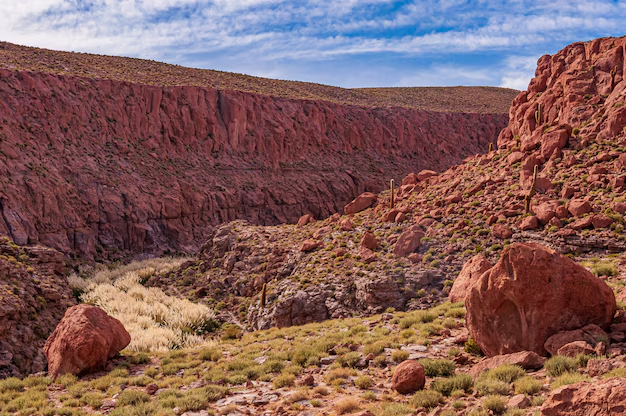
The classic three-day, two-night circuit is a different proposition. It crosses the Salar and continues south through high desert into the Eduardo Avaroa reserve: Laguna Colorada with its red mineral water and flamingo colonies, steaming geyser fields at dawn, hot springs where you soak while the air is near freezing, wind-carved rock formations, and Laguna Verde beneath Licancabur volcano. Many operators can finish at the Chilean border, dropping you towards San Pedro de Atacama, which makes a neat overland link between two countries.
Be clear-eyed about the accommodation. Nights on the circuit are basic. Expect shared rooms, salt-block lodges, limited or no heating, thin walls, intermittent electricity and sometimes no hot water. This surprises people more than anything else on the trip, including the altitude. It is not a failure of the operator; it is what infrastructure looks like at 4,000-plus metres in a remote reserve. Go knowing that and it becomes part of the experience.
Operator choice matters here more than almost anywhere else we send clients. Vehicle condition, tyre and spare provision, driver rest between departures, radio or satellite contact, and group size are genuine safety variables on long empty desert stretches with no phone signal and no passing traffic. The cheapest quote in Uyuni town is cheap for reasons that only become visible when something goes wrong. This is also exactly the sort of trip where comprehensive travel insurance for Indian travellers with high-altitude and evacuation cover stops being optional.
Practical things nobody mentions until you are there
Ultraviolet exposure at this altitude is severe, and the salt reflects light upward into your face from below. Sunglasses that actually block UV, high-SPF sunscreen reapplied through the day, lip balm with sun protection and a brimmed hat are not comfort items here — people get burnt under their chin and on the underside of their nose. Bring layers you can peel and re-add, because a single day swings from strong sun to sub-zero wind.
Salt corrodes. It gets into camera bodies, lens barrels, zips, shoe seams and tripod legs, and it keeps working after you leave. Wipe gear down each evening and rinse footwear when you can. Cold flattens camera batteries fast, so carry spares close to your body, and be aware that thin air affects drone lift and flight time — some areas also restrict drones outright, so ask before flying. Connectivity is limited to absent for much of the circuit; an eSIM sorted before departure helps in La Paz and Uyuni town but will not save you in the reserve.
Bolivia runs largely on cash. ATMs in Uyuni are few and can be out of service or out of notes, so arrive with enough bolivianos for tips, entry fees, drinks and incidentals. Card acceptance outside larger towns is unreliable. Sensible planning around carrying and converting money for international trips is worth doing before you fly rather than improvising on arrival, and a run through a thorough packing checklist for overseas travel will catch the cold-weather items Gujarat wardrobes usually lack.
What it costs, honestly
We will give ranges, not figures dressed up as facts, because airfares to South America swing wildly by season and booking window. For a two-week South America trip from India built around Uyuni — international flights, internal transport, mid-range accommodation, the Salar tour and daily costs — most of our clients land somewhere in the region of ₹2,50,000 to ₹4,50,000 per person. Travelling in peak northern-summer or festival periods, choosing better hotels in La Paz and Cusco, or adding Patagonia or the Amazon pushes it higher. Careful fare timing, hostel-and-guesthouse accommodation and slower overland transport pull it down.
Treat that as indicative only. The Salar tour itself is a modest share of the total; the flight is the dominant line item, which is precisely why visiting Bolivia alone rarely makes financial sense. For a structured way to think about it, our note on building a realistic overseas trip budget from Gujarat walks through the categories most people underestimate.
Fitting Uyuni into a real itinerary
Given the flight length, we almost always build Bolivia into a twelve to eighteen day multi-country trip. A shape that works well: arrive into La Paz and give it two or three days to acclimatise, add Lake Titicaca and Copacabana on the Bolivian side, then fly or take the overnight bus down to Uyuni for the salt flat, and exit either west into Chile at San Pedro de Atacama or north into Peru.
The Peru extension is the most popular with our Gujarat clients, and it earns the extra days. Cusco, the Sacred Valley and Machu Picchu pair naturally with Bolivia because you are already acclimatised to altitude by the time you arrive. If that is your direction, planning a Machu Picchu visit from India and what to do with your days in Cusco cover the permits and pacing. Travellers with more time sometimes push further south to the mountains and glaciers of Argentine Patagonia or east to the beaches and neighbourhoods of Rio de Janeiro, though both add meaningful cost and flying time.
Food, and eating vegetarian or Jain
Bolivian cooking leans on potatoes — dozens of varieties — plus quinoa, corn, and a lot of meat. In La Paz you will manage comfortably: the city has vegetarian restaurants, international food, and markets full of fruit, nuts and bread. Soups, quinoa dishes, salteñas in vegetarian versions and simple rice-and-vegetable plates are all findable.
On the multi-day circuit it is much tighter. Meals are cooked by the driver-guide from supplies loaded at the start, in places with no shops for hours in any direction. Tell the operator your requirements at the time of booking, not on the morning of departure, and follow up in writing. Then carry your own backup: dry snacks, theplas that travel, nuts, instant khichdi or upma sachets, and a flask. Hot water is usually available even when food options are not.
A strict Jain traveller should plan seriously rather than hope. Root vegetables are the backbone of the local diet, which makes the standard tour menu difficult in principle. It is workable, but it needs a specific conversation with the operator, an itinerary built around it, and a properly stocked food bag. Our team has arranged this before and it is easier to solve at booking stage than in Uyuni.
Being a decent guest
The Salar is not an empty stage. It is a working salt-harvesting area, and Aymara and Quechua communities live around its edges and have done so for a very long time. You will see salt piled in conical heaps to drain, and people working in hard conditions. Ask before photographing anyone, and accept a refusal gracefully. Do not take salt away as a souvenir. On Isla Incahuasi, stay on marked paths and do not touch or carve the cacti — some of them are centuries old and grow at a pace measured in centimetres per decade. The colour-tinted lagoons further south are fragile flamingo habitat; keep your distance and keep noise down.
If this is your first long-haul trip, our first-time international travel checklist for Gujarat travellers covers the groundwork, and families travelling with older parents will want to read how to plan overseas travel with senior citizens before committing to an altitude itinerary — Uyuni is not automatically ruled out for older travellers, but it does need medical clearance and a gentler acclimatisation plan.
Talk to us before you book
Uyuni rewards preparation more than most destinations. Get the season right for the photographs you actually want, give yourself real acclimatisation days, choose an operator on safety rather than price, sort the visa and any transit visa early, and combine Bolivia with Peru or Chile so the long flight earns its keep. Do those five things and the rest tends to take care of itself.
Our team in Surat has put together South America itineraries for families, honeymooners and solo travellers, and we are happy to walk you through routings, seasons and operator options before you commit to anything. Get in touch with Explera Vacations with your dates and rough budget, or look through our curated tour packages departing from Surat for a starting point. We would rather have a long conversation now than manage a disappointment later — and with a destination this far away and this weather-dependent, that conversation is genuinely worth having.