There are very few capital cities in Europe where the recent past is still so visibly written on the streets. Tirana is one of them. For nearly half a century, Albania was governed by one of the most closed and controlling communist regimes on the continent — borders shut, religion banned, foreign travel effectively impossible, and a secret police apparatus that reached into ordinary households. The country opened only in the early 1990s. Everything you see in Tirana today has been built, painted, rebuilt or reinterpreted since then, and much of it within the last fifteen years.
That is the frame we would ask you to carry into the city, because without it Tirana can read as simply scruffy and colourful. With it, the city becomes one of the more moving places you can spend three days in Europe. Our team in Surat has been sending travellers to Albania with increasing frequency, and the feedback is consistent: people arrive with low expectations and leave saying it was the most interesting stop of the trip.
Skanderbeg Square and the shape of the centre
The city organises itself around Skanderbeg Square, named for the fifteenth-century commander who held off Ottoman armies and became Albania's national hero. It was for years a traffic roundabout; it is now an enormous pedestrianised plaza, paved in stone quarried from across the country, with a gentle rise at the centre so that it drains outward and reads almost as a shallow hill. On a warm evening it fills with families, teenagers on scooters and men in folding chairs, and it is genuinely one of the great public spaces of the Balkans.
On its edges sit the pieces that tell you where you are. The Et'hem Bey Mosque, small and eighteenth-century, survived the regime's ban on religious practice and reopened in 1991 to enormous crowds; its interior frescoes of trees, bridges and waterfalls are unusual in Islamic decoration and worth the few minutes it takes to see them. Beside it stands the clock tower, which you can climb for a low-level view across the square. And on the north side, the National History Museum carries a vast socialist-realist mosaic across its facade — figures striding forward with rifles and books, a piece of state art that the city has kept rather than erased.
The painted buildings, and why they matter
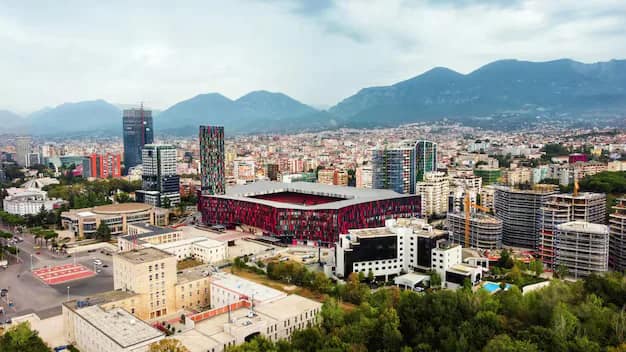
If you have seen a photograph of Tirana, it was almost certainly of an apartment block painted in stripes, blocks or bright geometric patterns. This is not municipal whimsy. In the early 2000s, Edi Rama — a painter by training, then mayor of the city, later prime minister — began having the grey communist-era housing blocks painted in strong colours. The buildings themselves were unchanged: same plumbing, same stairwells, same problems. What changed was how the city felt to the people living in it.
Rama's own account of the project is that residents began reporting they felt safer, that shopkeepers took down the metal grilles from their windows, that people started paying municipal taxes they had previously ignored. Whether every claim holds up to scrutiny is debated, but the underlying idea was serious: after decades in which the state had told citizens the public realm was not theirs, colour was a cheap and immediate way of saying otherwise. It was an act of civic morale, done by an artist who happened to hold office, and it is the single best story about how this city changed. It is also, straightforwardly, why Tirana photographs the way it does.
The communist-era sites, taken seriously
Under Enver Hoxha, who ruled from the end of the Second World War until his death in 1985, Albania built an extraordinary paranoid infrastructure. Somewhere in the region of hundreds of thousands of small concrete bunkers were poured across the country against an invasion that never came, and you will still see them in fields, on beaches and beside roads. Two vastly larger bunkers were built for the leadership, and both are now museums.
Bunk'Art 1, on the edge of the city near the Dajti cable car, is an enormous multi-level shelter built for Hoxha and the military command, its rooms now given over to the history of the dictatorship and to art installations. Bunk'Art 2, in the centre near Skanderbeg Square, occupies a bunker built for the interior ministry and deals specifically with the Sigurimi, the secret police. The House of Leaves, a short walk away, was the surveillance headquarters itself: a quiet villa where wiretaps were run, informers handled and files kept, now a museum about exactly that apparatus.
These are not novelty attractions. People were imprisoned, interned, tortured and executed under this system, and many families in Albania still carry that directly. What is striking, and worth saying plainly, is that Albanians themselves built these museums so the record would be public and legible rather than quietly buried. Go, take your time, and give the rooms the attention they are asking for. Two of the three in a single day is plenty; three is too much.
The Pyramid of Tirana completes the picture. Built in the late 1980s as a museum glorifying Hoxha, designed in part by his daughter, it later served as a conference centre and NATO base, then spent years derelict and covered in graffiti, climbed by teenagers who slid down its concrete flanks. Rather than demolish it, the city has converted it into a youth and technology centre, with proper stairs up the outside so you can now walk to the top legitimately. A monument to a dictator, turned into a place where teenagers learn to code, is about as neat a summary of modern Tirana as you will find.
Blloku: the district that used to be forbidden
A ten-minute walk from the square is Blloku, and the reversal here is the whole point. This neighbourhood was reserved for the party elite and closed to ordinary Albanians; guards controlled access, and Hoxha's own villa stands within it. Today it is the densest concentration of bars, cafés, restaurants and boutiques in the country — busy from mid-morning coffee until late, and the place where the city's young middle class is most visible. Sit outside with a coffee and it takes an effort of imagination to remember that ordinary citizens were not permitted to walk here within living memory.
Up the mountain, and out into the country
For perspective on where the city sits, take the Dajti Ekspres cable car up Mount Dajti. It runs from the eastern edge of Tirana and lifts you well above the basin in something over a quarter of an hour, opening onto a view across the whole city and the plain beyond towards the Adriatic. There are restaurants at the top and easy walking in the national park. Go on a clear day; the view is the entire reason.
Tirana is also the natural gateway to the rest of Albania, which is where most of the country's scenery lives. Krujë, with its hilltop castle and restored Ottoman bazaar, is about an hour away and makes an easy half-day. Berat and Gjirokastër, both UNESCO-listed Ottoman towns of stacked stone houses and shuttered windows, are the two set-piece destinations inland. Durrës and its long beaches are a short drive west. Further south lies the Albanian Riviera — Himarë, Dhërmi, Ksamil — with water that genuinely rivals anything in the Mediterranean. And to the north are the Accursed Mountains, where the walk between two remote villages has become one of Europe's best-known hikes; we have written about that route in detail in our trekking guide to Valbona and Theth in the Albanian Alps.
Getting there from Gujarat
There are no direct flights from India to Albania, and there is unlikely to be one soon. Everything routes through a hub. From Ahmedabad, Mumbai or Delhi you will typically connect via Istanbul, a Gulf hub such as Dubai, Doha or Abu Dhabi with an onward European leg, or through Rome, Vienna, Milan or another European gateway into Tirana International Airport (TIA), the country's main airport, which has become far better connected in the last few years as low-cost carriers have moved in.
For travellers starting in Gujarat, Istanbul is usually the most practical single-stop routing: one connection, reasonable timings, and a short final hop across the Adriatic. If you are working out how to get to a hub in the first place, our notes on flying internationally out of Gujarat's airports and our approach to finding cheaper long-haul fares from India are the place to start. Check your through-baggage carefully when two separate airlines are involved — the rules are covered in our breakdown of international baggage allowances.
The visa question — read this part carefully
This is genuinely one of Albania's strongest cards for Indian passport holders, and also the part where we most need you to be careful. Albania is not in the Schengen area. Its entry rules are its own, and they have historically been unusually generous: Albania has, for several years, permitted visa-free entry to Indian nationals who hold a valid, previously-used multiple-entry Schengen, UK or US visa, and it has at times run seasonal visa-free periods open to particular nationalities regardless of other visas held.
The mechanism is what matters: the country is effectively recognising that if a major partner has already vetted you, it need not repeat the exercise. But these arrangements are announced, extended, amended and allowed to lapse from year to year, and the precise conditions — which visa types qualify, whether the visa must show prior use, how long you may stay — are not fixed. We will not state durations, seasonal windows or fees here, because anything we wrote would risk being wrong by the time you read it. Verify the current position with the Albanian embassy or the official Albanian government source before you book flights, and let us check it alongside you — that is part of what our visa assistance desk in Surat does. You can also see our current country notes on the Albania visa requirements page and the wider country-by-country visa reference.
One planning point that genuinely matters: because Albania sits outside Schengen, days spent there do not count against your Schengen 90/180 allowance. On a long European trip that is a real lever — you can pause the Schengen clock in Albania and resume it afterwards. If you are also applying for Schengen, our step-by-step Schengen application walkthrough for Gujarat applicants and the note on choosing which Schengen consulate to apply through will save you time. It is also worth reading up on the EU's new biometric entry-exit system and what it means for Indian passengers, since it changes how those 90 days are counted at the border.
When to go
Spring and autumn — broadly April to June, and September into October — are the sweet spot. Warm enough for the coast at the shoulders, comfortable for walking the city, and without the crush. July and August are hot in Tirana, which sits inland in a basin and holds heat, and the Riviera is packed with domestic and diaspora holidaymakers at prices to match. Winter is mild, wet and quiet, and easily the cheapest time to come; the mountains are beautiful and the museums are empty.
One honest caveat about that basin: Tirana can hold poor air quality and visible haze, particularly in winter when heating, traffic and still air combine. It is not usually severe by the standards of a large Indian city, but if anyone in your group is asthmatic, it is worth knowing before you plan a January trip.
On the ground: money, traffic and manners
Albania uses the lek, not the euro, and while cards are accepted more widely every year, cash still matters more than it does in Western Europe — small cafés, bakeries, village guesthouses and taxis often want it. ATMs are plentiful in Tirana, less so once you are in the mountains, so draw what you need before heading out. Our guide to forex, cards and carrying money abroad from India covers how we usually structure this.
The traffic deserves a plain warning. Tirana drives assertively, lane discipline is loose, and pedestrian crossings are treated as a suggestion by a meaningful share of drivers. Gujarati travellers are generally less rattled by this than northern Europeans are, but do not assume a zebra crossing confers protection. Cross with locals, make eye contact, and move decisively. Beyond that the central city is very walkable, and you will not need taxis for most of a two-night stay.
Two things travellers report consistently. The first is that Albanians are genuinely, unforcedly hospitable to visitors — unusual generosity with directions, with time, with an extra coffee that does not appear on the bill. The second is a practical detail worth memorising: the head gesture for yes and no can be the reverse of what you expect, with a shake often meaning agreement and a nod meaning refusal. It is not universal, and younger urban Albanians often use the international version, but it causes real confusion. When it matters, ask for words rather than reading the head.
Eating well, including without meat
Albanian cooking is Mediterranean with a strong Ottoman inheritance, and it is considerably better for vegetarians than most travellers expect. Byrek — flaky layered pastry — comes filled with spinach or with fresh white cheese, sold from dedicated shops all morning. Fërgesë, the dish most associated with Tirana, in its vegetarian form is peppers and tomato cooked down with cheese and served bubbling. Stuffed peppers, grilled vegetables, white beans, lentil and vegetable soups, and simple plates of tomato, cucumber, olives and cheese are everywhere. The tomatoes and olive oil are excellent, the bread is good, and yoghurt and fresh cheese are staples rather than afterthoughts.
Be clear-eyed too. Meat and dairy are foundational to the cuisine, and byrek very often comes in a meat version, so you must specify. Stock and animal fat can appear in things that look vegetarian, and it is worth asking directly rather than assuming. A strict Jain traveller will find onion and garlic in almost everything savoury — planning ahead is essential, and we usually suggest a mix of self-catered breakfasts, fruit and bakery items, plus a few restaurants briefed in advance. Tirana has a growing number of vegan and health-focused cafés, mostly clustered around Blloku, which help considerably.
What it costs, and how long to give it
Albania is one of the best-value countries in Europe, and we say that without exaggeration — accommodation, eating out, transport and entry tickets all sit well below Western European levels, and often below Central European ones. As a rough, indicative planning figure for an 8 to 11 day Albania trip from Gujarat, we would budget roughly ₹1,10,000 to ₹1,90,000 per person all-in, including return flights via a hub, mid-range accommodation, transfers, most meals and entrances. Travelling in July and August, or wanting sea-view hotels on the Riviera, pushes you toward and past the upper end; a winter trip on a well-timed fare can land below the lower one. These are ranges, not quotes — season, routing and how far ahead you book move them substantially. Our framework for building an international trip budget from Gujarat explains how we put these numbers together.
For shape, we usually suggest Tirana as two or three nights at the front of the trip. That gives you the square, the painted city, two of the communist-era museums, an evening or two in Blloku and the cable car, without rushing any of it. From there the natural line runs south — Berat, then Gjirokastër, then out to the Riviera — and back north if you want the Alps. Alternatively, Albania links overland with Montenegro, Kosovo and North Macedonia into a longer Balkans loop, which is how a number of our clients have combined it with a first European trip. If Europe is new to you, our first-timer's Europe itinerary from India is a useful companion to this one.
Before you go
Two practical things we insist on with every client. Take proper travel insurance with medical evacuation cover — Albania's hills and mountain roads are not the place to discover you skipped it, and our notes on choosing travel insurance as an Indian traveller explain what to look for. And sort your connectivity before departure rather than at the airport; an eSIM is far simpler than hunting for a local SIM on arrival, as we set out in our eSIM and international SIM comparison for Indian travellers. If this is a first trip abroad for anyone in the group, our first international trip checklist for Gujarat travellers and the what-to-pack list for international travel will cover the rest.
Tirana is not a polished city and it is not trying to be. It is a capital that has spent thirty-odd years working out what it wants to be after a period it is still processing, and it does that work in public, in bright paint, in museums built inside bunkers. For an Indian traveller it is affordable, unusually easy to enter, genuinely welcoming, and unlike anywhere else you will go in Europe.
If you would like help putting an Albania trip together — routing from Ahmedabad or Mumbai, checking the current entry position for your passport and existing visas, and building an itinerary that runs from Tirana down to the coast — get in touch with our team or come and see us at our Surat travel and tour desk. We will be straight with you about what is worth your days and what is not, and we will verify the visa position in writing before you book anything.