Most Caribbean dreams collapse at the planning stage. You read about turquoise water and powder sand, then discover the island floods every September, the flights involve three changes, and nobody can tell you clearly what visa an Indian passport actually needs. Aruba is the rare island where two of those three problems mostly disappear — and where the third one, the visa question, has a specific answer that catches a surprising number of travellers out. This guide is written for readers in Surat and Gujarat who are seriously considering the southern Caribbean, and it is deliberately honest about what the trip costs in effort as well as rupees.
Why Aruba works when other Caribbean islands do not
Aruba sits far south in the Caribbean, close to the Venezuelan coast, and that geography does most of the heavy lifting. The island is genuinely arid — cactus, scrub and the famous wind-bent divi-divi trees rather than rainforest — so it does not get the long tropical downpours that define much of the region. A steady trade wind blows almost every day, which keeps the heat comfortable even in the middle of the afternoon. Most importantly, Aruba lies outside the main Atlantic hurricane belt. Storms are not impossible, but the island is rarely in the firing line the way the eastern Caribbean is between August and October. In practice this makes Aruba a year-round destination rather than a six-month one, which matters enormously when you are flying halfway around the planet and cannot easily move your dates. Do still check conditions close to travel, and read the latest travel advisory updates before you finalise anything.
Getting there from India — plan the routing before you book anything
There is no short way to Aruba from India. Realistically you are looking at a long routing with at least one, usually two, changes — most commonly via Europe (Amsterdam is the traditional gateway, given Aruba's Dutch ties) or via a US hub such as Miami, New York or Atlanta. Total travel time door to door from Surat, including the domestic leg to Mumbai or Delhi, is typically well over twenty-four hours. Here is the practical warning that matters most: a routing through the United States requires you to hold a valid US visa, even if you never leave the airport. The US has no international transit-without-visa facility for Indian passport holders. If you book a cheap Miami connection without a B1/B2 in your passport, you will not be allowed to board. If you do not already hold one, read our guide to applying for a US B1/B2 visa from Gujarat and note the recent changes to US visa fees and interview waivers, because appointment waits can add months to your timeline. If you would rather avoid that entirely, ask our flight desk in Surat to price a European routing instead — it is often only marginally more expensive once you account for the visa cost and the risk.
The visa reality: a Dutch island that is not Schengen
This is the single most misunderstood thing about Aruba. Aruba is a constituent country of the Kingdom of the Netherlands — Dutch is an official language, the architecture is Dutch colonial, the flag flies alongside the Dutch one. From that, travellers reasonably assume a Schengen visa covers them. It does not. Aruba is not part of the Schengen area, and a Schengen visa does not automatically grant entry there. Aruba operates its own entry rules and, separately, an online entry registration that travellers are expected to complete before arrival. Indian passport holders should verify the exact current requirement for their specific passport and routing well ahead of booking — not the week before departure — because the answer depends on your itinerary, and because any European or US transit leg carries its own visa requirement on top. If you are still building a mental model of which document does what, our explainer on how different visa categories actually work is a useful starting point, and it is worth seeing where the Indian passport now travels visa-free so you know which parts of a multi-stop trip are genuinely easy. When in doubt, let our visa team in Surat confirm the current position for your case — please verify current rates and entry requirements before you pay for anything non-refundable.
Eagle Beach, Palm Beach and where it is safe to swim
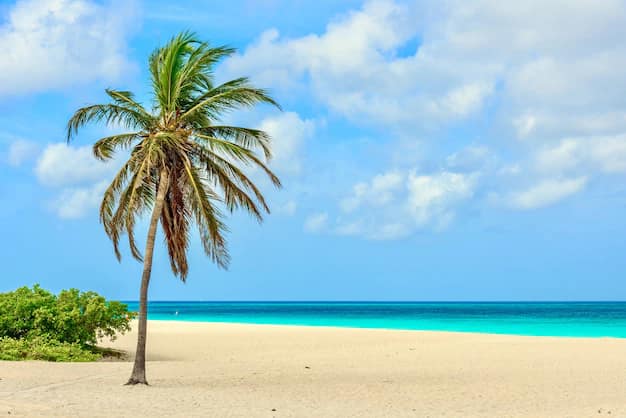
The two headline beaches are close together on the sheltered west coast, and they are not the same experience. Eagle Beach is the quieter one: an extraordinarily wide strip of white sand, low-rise hotels set back from the water, and space to actually walk. Its famous wind-sculpted divi-divi trees are the image most people carry home. Palm Beach, a few minutes north, is the busy one — high-rise resorts, water sports operators, beach bars, restaurants and a genuine evening buzz. Neither is better; they suit different holidays. Families who want dinner options and activity on tap tend to prefer Palm Beach, while couples and slower travellers usually fall for Eagle. In between and just south lies Oranjestad, the small capital, worth a half day for its Dutch colonial buildings painted in mango, turquoise and coral — it photographs beautifully in the late afternoon. One firm safety point: swim on the west and south-west coasts only. The wild north and east coasts are spectacular to look at, but the currents and shore break there are genuinely dangerous and there are no lifeguards. Look, photograph, do not enter the water. And be careful of the trade wind — that constant pleasant breeze masks how hard the sun is working, and people burn badly without ever feeling hot. Reapply high-SPF sunscreen far more often than instinct suggests.
Arikok National Park and the natural pool
Nearly a fifth of Aruba is protected inside Arikok National Park, and it is the opposite of the beach postcard — dry, rocky, cactus-covered, dotted with caves, old gold-mining ruins and Arawak rock paintings. The interior tracks are rough, and this is where travellers regularly go wrong: a standard rental car will not get you across the park, and rental agreements often explicitly forbid it. You need a proper 4x4, or better, a guided tour with a driver who knows the terrain. The destination most people are chasing is the natural pool (Conchi) — a rock-rimmed basin on the rugged north coast where the Atlantic swell breaks over the outer rocks and leaves a calm, protected pool inside. Getting there involves a jolting off-road drive followed by a short scramble down. It is worth doing, but treat it as a proper half-day excursion, wear real shoes rather than flip-flops, carry far more water than you think you need, and go with an operator rather than improvising. This is also the one part of an Aruba trip where a decent policy earns its keep — see our notes on choosing travel insurance with proper medical cover before you sign up for anything off-road.
Under the water: snorkelling and the Antilla wreck
Aruba's water is clear, calm on the leeward side, and warm all year, which makes it forgiving for first-timers. Snorkelling from shore works well at Boca Catalina and Malmok in the north-west, where the reef sits close in and you will see parrotfish, sergeant majors and the occasional turtle without needing a boat. The island's signature dive, though, is the Antilla — a large German freighter scuttled in the Second World War, lying in shallow water off the north-west coast. Parts of it sit close enough to the surface that competent snorkellers on a catamaran trip get a genuine view, while certified divers can penetrate the holds. There are other wrecks and reef sites too, and several operators run half-day sail-and-snorkel trips that suit families who do not dive. If anyone in your group is certified, carry your card; if nobody is, a discover-scuba session in the sheltered west-coast water is a reasonable, low-stress introduction. Book with established operators and confirm what safety cover is included rather than assuming.
Food, money and a 6–7 day plan
Aruban food is a genuine mix — Dutch, Caribbean, Latin American and increasingly international, thanks to the resort trade. Fresh fish is excellent, keshi yena (stuffed cheese) is the dish to try once, and the pastechi is the local snack you will end up eating for breakfast. Vegetarians will manage comfortably, though you must be specific: ask for dishes without fish stock, and lean on the Italian, Mediterranean and Latin restaurants where vegetable and bean dishes are properly part of the menu rather than an afterthought. There are also a small number of Indian restaurants, mostly clustered around the Palm Beach and Oranjestad areas, which are a relief mid-trip for anyone travelling with elders or with strict Jain or vegetarian requirements — but plan on cooking-free days rather than daily Indian food, and consider carrying some familiar staples. Aruba is not a budget destination: as a broad, hedged indication, a week for two travelling from India — long-haul flights, a mid-range west-coast hotel, some tours and eating out — has often landed somewhere in the range of roughly ₹4,00,000 to ₹7,00,000 or more depending on season, routing and hotel class, with luxury resorts pushing well past that. Treat those as planning brackets only and verify current rates and entry requirements before committing; our team can pin down real numbers for your dates, and we can also book your Aruba hotel through us if you would rather not juggle it yourself.
A sensible shape for six or seven days: Day 1 arrive, recover from the journey, sunset on Eagle Beach and an early night. Day 2 slow beach day on the west coast plus a walk around Oranjestad's colonial streets in the late afternoon. Day 3 the Arikok and natural pool excursion by 4x4 — a full, tiring, brilliant day. Day 4 a catamaran sail-and-snorkel trip including the Antilla wreck, back by mid-afternoon. Day 5 contrast day: drive the calmer south, see the California Lighthouse and the divi-divi trees, and view the wild north coast from safe ground. Day 6 whichever you loved most — repeat it properly, or add a diving session or a windsurf lesson at Hadicurari. Day 7 a final unhurried morning swim before the long journey home. That rhythm alternates hard days with soft ones, which matters when jet lag from India is still working through the group.
Frequently asked questions
Does my Schengen visa let me enter Aruba? No — not automatically. Aruba is part of the Kingdom of the Netherlands but sits outside the Schengen area and applies its own entry rules, plus a separate online entry registration. Check the specific requirement for an Indian passport on your exact routing well before booking, and remember any European or US transit leg needs its own visa on top.
When is the best time to visit? Aruba is a genuine year-round option because it is dry, breezy and outside the main hurricane belt. January to March is the peak season with the highest prices; May to early August and late autumn usually offer better value with very similar weather. September and October carry slightly more regional weather risk than the rest of the year, though far less than the eastern Caribbean.
Is it safe to swim anywhere on the island? No. Stick to the sheltered west and south-west coasts — Eagle Beach, Palm Beach, Baby Beach and the calm bays. The north and east coasts have strong currents and heavy shore break with no lifeguards, and should be treated as viewpoints, not swimming spots. Also respect the sun: the constant trade wind hides how strongly it is burning you.
Aruba rewards planning far more than most beach holidays, mainly because the routing and the entry rules have to be settled before anything else is booked. If that is the part putting you off, hand it to us — talk to Explera Vacations and we will confirm the current entry requirements for your passport, price both the European and US routings honestly, and build the trip around your dates. You can also browse our curated holiday packages from Surat if you would prefer a ready-made structure to start from.