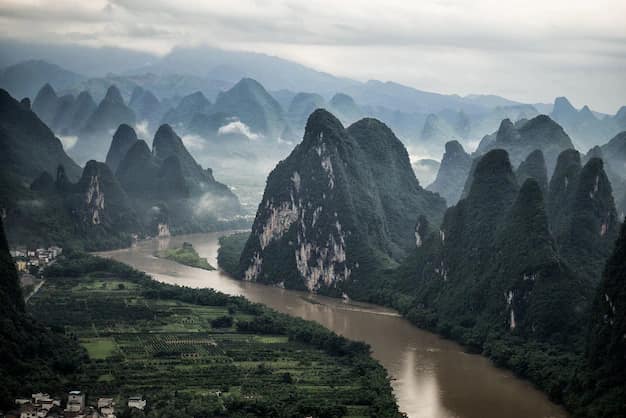
There is a particular kind of landscape that Indian travellers recognise long before they ever see it — grey-green limestone peaks rising straight out of flat farmland, a slow river winding between them, a bamboo raft with a single figure poling through the mist. It is the picture on every Chinese scroll painting, every tea tin, every calendar. That landscape is real, it is called karst country, and it sits along the Li River between the city of Guilin and the small town of Yangshuo in Guangxi province. For families and couples from Surat who have already done Southeast Asia and want something that feels genuinely different, this is one of the most rewarding weeks in Asia — provided you plan the paperwork early and go in with realistic expectations about how travel in China actually works.
The landscape on every scroll painting
Karst is what happens when soft limestone is dissolved by rain and rivers over millions of years, leaving behind isolated conical peaks that look almost deliberately arranged. The 80-odd kilometre stretch of the Li River between Guilin and Yangshuo is the most photographed example on earth, and for good reason — the peaks crowd right down to the water, farmers still work the fields between them, and water buffalo wade in the shallows. Near Yangshuo the river bends around Mashan mountain, and a little upstream at the old fishing village of Xingping there is a viewpoint so iconic that the scene was printed on the back of the 20-yuan note; people genuinely stand there holding up the banknote to line it up with the hills. Come evening you may still see cormorant fishermen on bamboo rafts with lamps and trained birds. Be honest with yourself about this one: today it is largely a staged demonstration for photographers rather than a working livelihood, and that is fine as long as you know what you are watching. The everyday scenes — a farmer cycling home along a dyke, mist lifting off the water at seven in the morning — are the ones that stay with you.
Flights from Gujarat, and the China visa to plan first
There is no direct flight from Surat or Ahmedabad to Guilin, so plan on connections. The usual routings go via a Southeast Asian or Gulf hub — Bangkok, Kuala Lumpur, Singapore, Hong Kong, Dubai or Doha — into Guangzhou or Shenzhen, and then onward to Guilin by a short domestic flight or by the excellent high-speed train (roughly two and a half to three hours from Guangzhou). Guilin's Liangjiang International Airport does receive some regional international flights from Asian hubs, and these come and go with the season, so treat any direct-to-Guilin option as a bonus to be verified rather than assumed. Realistically you are looking at one or two changes and a long travel day in each direction from Gujarat. Our team handles this kind of multi-sector routing every week — talk to us about flight bookings from Surat so the connection times are sensible and your baggage is checked through properly rather than being reclaimed at every stop.
Now the part that decides whether your trip happens at all. China requires a visa for Indian passport holders — there is no visa-free entry for us, and you should be sceptical of any blog or reel that suggests otherwise. The tourist visa process typically involves an appointment at a Chinese visa application centre, a set of supporting documents including confirmed travel arrangements, and biometric submission in person, which for most Gujarat travellers means a trip to the designated centre serving your region. Requirements, appointment availability and processing times change from time to time, so start at least six to eight weeks before departure and verify the current rules before you book anything non-refundable. You can read what we currently list on our China visa requirements page, and if the categories confuse you, our explainer on the different types of travel visas Indians apply for is a good grounding. For hand-holding through appointments, document sets and formatting, our visa consultants in Surat do this daily. If you are curious how China compares with the destinations that have opened up for us lately, our piece on how far the Indian passport now reaches puts it in context.
When to go: green spring, golden autumn, misty winter
Spring (roughly late March to May) and autumn (late September to early November) are the sweet spots — comfortable temperatures, clear-ish light and the countryside at its best. Summer, from June through August, is genuinely hot and humid, with heavy afternoon downpours; the hills are lush and the river runs high, but it is sticky work, and this is also peak domestic holiday season, which means crowds. Winter is cold, damp and quiet, and here is the honest trade-off: winter mist frequently hides the peaks altogether, and you can spend a whole morning seeing very little — but that same mist is exactly what turns the Li River into the ink-wash painting people travel here for. Some of the most beautiful photographs from this region are shot in miserable weather. If you like the sound of that, go in winter and pack layers; if you want reliable views and warm afternoons, go in spring or autumn. Gujarat travellers who plan trips around season windows may also find our comparison of when to visit Thailand, Vietnam and Bali useful, since many China itineraries are combined with a stopover in one of those hubs anyway.
The Li River: full cruise or bamboo raft?
You have two honest choices, and they suit different travellers. The full-length cruise runs from a pier near Guilin down to Yangshuo and takes roughly four to five hours, with a proper boat, a seat, a toilet and a simple lunch. It covers the entire classic stretch, including the sections you cannot reach any other way, and it is the right pick for older parents, families with small children and anyone who wants the whole postcard in one sitting. The downside is that it is a fixed schedule, it can be busy, and you are viewing from a deck rather than being in the landscape. The bamboo raft — nowadays usually a motorised PVC raft rather than actual bamboo — runs a much shorter section, most famously from Xingping past the 20-yuan viewpoint, and takes well under an hour. It is cheap, low and close to the water, wonderful for photographs, and far more atmospheric at dawn. It is also weather-dependent and gets suspended when the river runs high after rain. Our suggestion for a first visit: do the shorter raft at Xingping early one morning for the light and the intimacy, and take the full cruise on a separate day if the scenery is the whole point of your trip. Do not book both on the same day and expect to enjoy either.
Longji rice terraces, the Yulong valley and West Street
About two to three hours north of Guilin, the Longji (Dragon's Backbone) rice terraces climb the hillsides above villages like Ping'an and Dazhai in curved, stacked ribbons that have been farmed for centuries. Be clear-eyed about timing: the terraces are at their most photogenic in late spring, when they are flooded and mirror the sky, and in late summer to early autumn, when the rice turns gold before harvest. Outside those windows they can look like plain brown hillside, and in winter they are often bare or dusted with snow. Reaching the best viewpoints involves real uphill walking on stone steps, so it is worth an overnight stay in a village guesthouse rather than a rushed day trip, and worth being frank with us about your family's walking ability so we plan the right village. Back down in Yangshuo, the mood is completely different. The Yulong River valley just outside town is flat, quiet farmland threaded with lanes, old stone bridges and small karst peaks, and it is best seen from a bicycle or an e-bike — a half-day of easy pedalling past villages and bamboo groves is, for many travellers, the single best thing they do in China. A short raft on the shallow Yulong is a gentler alternative to the Li River. In town, West Street is the loud, neon, souvenir-and-snack heart of Yangshuo. It is unapologetically touristy, it is fun for an evening, and it is not why you came — we usually suggest staying in a countryside hotel outside town and dipping into West Street for dinner rather than the other way round. Ask us about hotel bookings arranged from Surat if you want that split done well.
Practical notes for Indian travellers: payments, apps, food and cover
This is where China differs most from the Southeast Asia trips many Gujarat families are used to, and where a little preparation transforms the experience. Many apps and services you rely on at home may not work as expected in China, and everyday life runs on mobile payments rather than cash or foreign cards. Small restaurants, raft operators, ticket counters and village shops overwhelmingly expect a QR-based mobile payment, and while the major Chinese payment apps have improved their support for foreign cards, it is not something to discover for the first time at a ferry counter. Carry some cash as a backup, expect that not every vendor will take it happily, set up whatever payment and connectivity arrangements you need before you fly, and understand that a local guide or a well-briefed operator smooths all of this enormously — tickets bought in advance, transfers arranged, someone to talk to a driver in Mandarin. Food deserves the same honesty. Guangxi cooking is rice-noodle country and it is delicious, but vegetarian and especially Jain requirements take genuine effort in China: broths are commonly meat-based, onion and garlic are everywhere, and a dish described as vegetable may still be cooked with pork stock or fish sauce. It is entirely doable — we have sent plenty of vegetarian and Jain travellers to China happily — but it needs your guide and hotels briefed in writing, in Mandarin, in advance, and a willingness to eat simply on some days. Two more things before you book: arrange proper travel insurance for your international trip, and check your government's current travel advisory before booking — our travel advisory updates for Indian travellers is a useful starting point, but always confirm against the official source at the time you travel.
Frequently asked questions
How many days do I need, and what does a sensible itinerary look like? Five to six nights on the ground is the sweet spot. A workable shape: Day 1 arrive Guilin, settle in, evening walk by the Two Rivers and Four Lakes; Day 2 day trip north to the Longji rice terraces, ideally with an overnight in a terrace village if the season is right; Day 3 the Li River cruise from Guilin down to Yangshuo, checking into a countryside hotel outside town; Day 4 early raft at Xingping for the 20-yuan viewpoint and mist, afternoon at leisure, evening on West Street; Day 5 cycling the Yulong River valley, small villages and old bridges; Day 6 slow morning, transfer back to Guilin for your onward flight. Add a night if you want Longji as a proper overnight rather than a long day, and add a Guangzhou, Hong Kong or Bangkok stopover if your routing suggests it.
What should a Surat family budget for this trip? As a hedged guide only: return flights from Gujarat with one or two connections often land in the range of roughly ₹45,000–₹95,000 per person depending on season, hub and how early you book. On-ground costs — mid-range hotels, transfers, the cruise and raft tickets, Longji entry, a guide and meals — commonly work out to somewhere around ₹6,000–₹14,000 per person per day, with the higher end reflecting private guiding, better countryside hotels and peak season. Visa costs, insurance and connectivity are additional. These are planning ranges, not quotes: please verify current rates and entry rules before you commit, and let us build you an actual costing once we know your dates and the standard of hotel you want.
Is Guilin and Yangshuo suitable for older parents or young children? Yes, with the right design. The Li River cruise, the shorter Xingping raft, the Yangshuo countryside and the town itself are all comfortable for most fitness levels. The parts that demand real effort are the Longji terrace viewpoints, which involve steep stone steps and can take an hour or more of climbing, and long cycling days in summer heat. We regularly plan this region for three-generation families by keeping the base in one countryside hotel, using private vehicles instead of public transfers, and letting different members of the group do different things on the terrace day — the language barrier is the bigger practical challenge than the terrain, which is precisely what a good local guide solves.
Guilin and Yangshuo reward travellers who plan properly and rush nothing — the visa sorted early, the season chosen deliberately, the food conversation had in advance, and a couple of unhurried mornings on the water. If that sounds like your kind of trip, talk to our Explera Vacations team in Surat and we will build the routing, the paperwork and the on-ground guiding around your dates. You can also browse our curated tour packages from Surat if you would rather start from something ready-made and adjust it. Whichever way you go, please verify current rates, visa requirements and your government's travel advisory before you book.