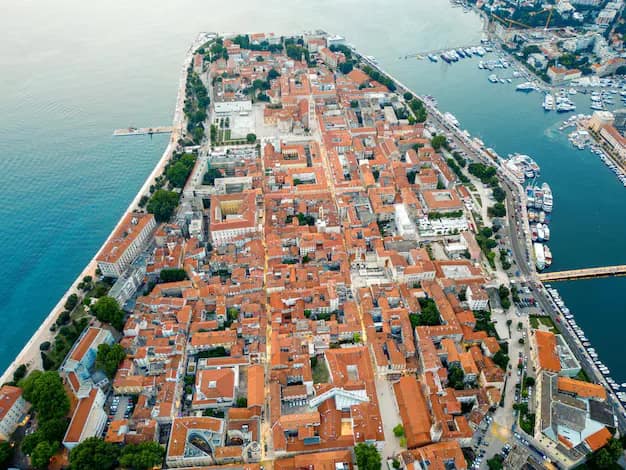
Most Croatia itineraries that cross our desk in Surat look the same: Zagreb, Plitvice, Split, Dubrovnik, home. Zadar gets a lunch stop on the drive south, if it gets anything at all. We have been quietly rearranging that order for a few years now, because Zadar is the Dalmatian city that rewards the traveller who actually stops. It is a working peninsula town of roughly seventy-five thousand people, layered with three thousand years of Illyrian, Roman, Venetian, Habsburg and Croatian history, and it is not organised around cruise ships. That single fact changes how a holiday feels.
The pitch: everything the coast is famous for, without the queue
Dubrovnik is extraordinary and we send people there happily, but by mid-morning in July the Stradun belongs to tour groups. Split is livelier and more real, but Diocletian's Palace has become a very crowded living room. Zadar sits on a low limestone peninsula about halfway up the coast, and its old town does the same trick — marble streets polished by centuries of feet, Roman columns lying about, churches older than most of Europe's cathedrals — while still being a place where people buy vegetables and take their children to school. You will hear Croatian in the cafes rather than six languages of tour commentary.
Zadar's other famous claim is the sunset. Alfred Hitchcock stayed here in the sixties and declared that Zadar had the most beautiful sunset in the world, more beautiful than Key West. The city has not stopped mentioning it since, and honestly, good for them — it is a fine piece of self-promotion built on something true. The sun goes down behind the islands of Ugljan and Pašman, the water turns the colour of beaten copper, and the whole town drifts to the western waterfront to watch. It is a genuine civic ritual, and it is free.
The Sea Organ: a building that the Adriatic plays
The reason we push Zadar to clients who think they have seen enough old towns is a set of marble steps. On the western tip of the peninsula, the architect Nikola Bašić rebuilt a stretch of dull post-war concrete embankment as a broad staircase descending into the sea. Beneath the steps run thirty-five tuned polyethylene pipes of different lengths and diameters, arranged in seven groups. As the swell rises and falls, it pushes air up through the pipes, which resonate and emit sound through slots cut in the top step. The sea plays chords. Nobody performs; there is no switch.
What makes it worth explaining properly is that the music never repeats. The pitch set is fixed — it is built around a diatonic chord structure, so it always sounds harmonious rather than random — but the timing and layering depend entirely on the water, which depends on the wind, the boat traffic and the tide. On a flat calm evening you may get very little: long silences and the occasional low sigh. On a breezy evening, or when a ferry has just gone past and pushed a wake in, it swells into something like a slow, breathing pipe organ that you feel through the stone you are sitting on. A little wind is a bonus here, not a problem. We tell people to go twice, on two different evenings, precisely because it will not be the same twice.
A few steps along the same waterfront is Bašić's companion piece, the Greeting to the Sun: a large circle of glass plates set flush into the pavement, with photovoltaic cells underneath. It soaks up sunlight all day and, after dark, runs a slow programme of coloured light across the circle, powered by what it collected. Children run across it, teenagers photograph themselves on it, and the whole waterfront turns into an open-air evening room. Both installations are free, permanently open and unfenced, which is refreshingly unusual for a headline attraction anywhere in Europe.
The Roman forum, St Donatus and the walls
Walk two minutes inland and you are standing in the largest Roman forum on the eastern Adriatic, laid out from the first century BC. What we like about it is how unpolished it is: broken columns and carved fragments simply lie where they have ended up, grass growing between them, with a single tall pillar still standing. Rising directly out of one edge is St Donatus, a great cylindrical church from the ninth century, built partly from Roman stone lifted straight out of the forum — you can see reused altars and inscriptions in its foundations. It is no longer used for regular worship, but its extraordinary circular acoustics mean it hosts concerts, and hearing early music inside it is one of the better evenings available on this coast.
Next door, the cathedral of St Anastasia carries a Romanesque facade and a nineteenth-century bell tower you can climb; the staircase is narrow and steep, and the reward at the top is the clearest possible explanation of the city's geography — the whole peninsula, the channel, the islands stacked behind one another. On the landward side, the Venetian Land Gate of 1543 still carries the winged lion of St Mark, and Zadar's defensive walls form part of the UNESCO listing of Venetian works of defence. If you have read our guide to the walled cities of Dubrovnik and Split, Zadar is the third chapter that most itineraries skip.
Why we actually recommend basing here: the national parks
This is the structural argument, and it is the honest one. Zadar is the best-placed base in Croatia for national parks — more of them are within reach from here than from any other coastal city. The Kornati archipelago, a scatter of roughly a hundred and forty largely bare limestone islands, is a full-day boat excursion from Zadar and its nearby harbours. Krka, with its boardwalks over travertine waterfalls, is a comfortable day trip south. Paklenica, the great pair of limestone canyons cut into the Velebit range, is under an hour away and offers everything from a two-hour gorge walk to serious multi-day hiking. And the lakes and waterfalls of Plitvice are within day-trip range inland, which very few people realise.
Add the islands. Ugljan is a short ferry hop and makes a lazy half-day of villages and olive groves. Dugi Otok, further out, holds Telašćica nature park — cliffs dropping over a hundred and fifty metres straight into the sea, with a saltwater lake behind them — and Sakarun, a long pale-sand beach with water the colour of a swimming pool, which is genuinely rare on this rocky coast. Put plainly: a traveller who gives Zadar four nights sees more variety of landscape than one who gives Split four nights. That is the whole case for the city, and we make it to clients every season.
A short, serious note on what the twentieth century left
Visitors often ask why an ancient city has so many plain mid-century buildings between the monuments. Zadar was very heavily bombed by Allied air raids in the Second World War, and a large part of the old town was destroyed and rebuilt simply and cheaply afterwards. Fifty years later the city was besieged and shelled during the Croatian War of Independence in the early 1990s, and the surrounding region saw serious fighting. This is recent, it is remembered, and it is treated seriously by people here. Mentioning it respectfully is fine; treating it as sightseeing is not.
Getting there from Gujarat
There are no direct flights from India to anywhere in Croatia, so every routing involves at least one change. The realistic options are a Gulf hub — Dubai, Abu Dhabi, Doha — or a European hub such as Frankfurt, Istanbul, Munich or Vienna, connecting onward. Zadar has its own airport (ZAD), served in summer by seasonal low-cost links from several European cities, and when the timings line up it is the neatest arrival. But we are honest with clients: that airport is seasonal and thin, the schedules change year to year, and building a whole itinerary around one summer-only flight is fragile. More reliably, fly into Zagreb (ZAG) or Split (SPU) and come overland. Zagreb to Zadar is roughly three hours on a comfortable motorway coach, and the descent through the Velebit tunnel to the first sight of the sea is a genuinely good travel moment.
From Gujarat, most of our clients connect through Mumbai or Delhi, though Ahmedabad's international links keep improving — our note on what flies internationally out of Gujarat's airports covers the current picture, and our approach to finding sensible airfares out of India is worth reading before you fix dates. Long connections are common on this route, so factor a night's rest into the first day rather than planning sightseeing on arrival.
Visa and paperwork
The single most useful thing to know is that Croatia joined the Schengen area and adopted the euro in January 2023. For Indian passport holders that simplified planning considerably: a Schengen visa now covers Croatia, there is no separate border formality when you arrive from another Schengen country, and there is no second currency to manage. Our Croatia visa page for Indian applicants sets out the current document logic, and the broader Schengen application process as it works from Gujarat explains the file itself: confirmed flight reservations, accommodation for the full stay, six months of bank statements and ITRs, employment or business proof, a covering letter with a day-by-day plan, and travel medical insurance meeting the mandatory Schengen minimum.
File with the consulate of the country where you will spend the most nights — for a Croatia-only trip that is Croatia; for a multi-country route the arithmetic matters, and choosing which Schengen consulate to apply through walks through it. Start roughly eight to ten weeks out, because appointment slots in Mumbai and Ahmedabad tighten badly before the summer. Fees change and we will not quote them here; check the official schedule at the time you apply. Also budget time for the EU's biometric entry-exit procedures, which are being rolled out at external borders and change what happens when you land — our explainer on the new biometric border system covers what to expect. Verify current rules before you travel, and if you have had a refusal before, the common grounds for Schengen refusal and how to reapply is the place to start. Do not treat the insurance as a tick-box either; what medical cover actually needs to do abroad is worth ten minutes.
Season, and the bura
June and September are the sweet spot. The sea is warm, the days are long, the ferries run full schedules and the town is busy without being overwhelmed. July and August are hot and crowded and accommodation prices climb steeply — August in particular is when Croatians themselves holiday, and island ferries and catamarans book out days ahead. May and October are lovely for walking and for the parks, with thinner crowds and lower rates, though the sea is cool and some island services thin out. Winter is quiet and cheap; many ferries reduce, some restaurants close, and the excursion economy largely stops.
One genuine planning fact: the bura, a fierce, dry, cold northeasterly that pours down off the Velebit mountains and hits this stretch of coast harder than almost anywhere else in the Adriatic. In strong episodes it closes the coastal bridges to high-sided vehicles, cancels ferries and catamarans outright, and makes exposed hiking unpleasant or unsafe. It is most common from late autumn through spring but can appear in any season. Build a spare day into island plans outside high summer, and never schedule a bura-vulnerable ferry on the same day as an international flight home.
On the ground: practicalities
The old town peninsula is compact — twenty minutes end to end at a stroll — entirely pedestrianised, and paved in marble that has been polished glassy by centuries of use. It is genuinely slippery in rain, so bring shoes with grip; this matters especially if you are travelling with parents or older relatives. The euro is the currency, cards are accepted almost everywhere including small cafes, and you will want some cash for markets, small ferries and tips. Our notes on carrying money and forex sensibly for a Europe trip apply directly. Ferries and catamarans to the islands leave from the town quay on the eastern side of the peninsula; book ahead in August. Connectivity is easy and cheap if you set up an eSIM before you leave India. And Zadar is markedly cheaper than Dubrovnik for the same standard of hotel, meal and coffee — often noticeably so in peak season.
Food, and eating vegetarian or Jain
We will be straight about this. Dalmatian cooking is built on fish, shellfish, lamb, cured ham and olive oil, and this is not the easiest region in Europe for a strict vegetarian. It is, however, entirely workable if you know what to ask for. Blitva — Swiss chard boiled with potato, garlic and good olive oil — is a standard side and a reliable staple. Grilled vegetables, roasted peppers, bean soups (check the base), tomato and cucumber salads, excellent bread, pasta and very good pizza are everywhere. Soparnik, a thin chard-filled flatbread from the Dalmatian hinterland, is worth seeking out. Fritule, small fried doughnuts, are the standard sweet. The produce, olive oil, figs and cheeses from the surrounding islands and Pag are genuinely first-rate.
Two honest cautions. Local cheese is often made with animal rennet, so ask if that matters to you, and fish stock turns up in soups, risottos and sauces where you would not expect it — the phrase to have ready is that you eat no meat, no fish and nothing made with fish or meat stock. A strict Jain traveller will need to plan around onion and garlic, which are foundational here; we usually build such itineraries around apartment stays with a kitchen, a supply of staples carried from home, and one or two Indian restaurants identified in advance in Zagreb or Split. It is doable, but it needs planning rather than improvisation. On the other side of the ledger, maraschino liqueur — distilled from marasca cherries — is a Zadar original with a long history and makes an excellent gift for anyone who drinks.
What a Croatia trip costs, roughly
Indicative only, and heavily season-dependent: for a 10 to 14 day Croatia trip from India, we would ask clients to plan on roughly ₹1,60,000 to ₹2,80,000 per person for flights, mid-range hotels, intercity transfers, park entries, excursions and daily meals, with June and September at the lower-middle of that band and peak August pushing past the top of it. Shoulder-season travel, apartment stays and two people sharing pull the number down; peak-season island hotels, private transfers and a heavy excursion programme push it up. National park entry is charged separately at each park and varies by season, and boat excursions are priced per person — we cost these individually once dates are fixed rather than guessing. How we build a realistic Europe budget from Gujarat explains the method.
Where Zadar sits in a 10 to 14 day Croatia trip
The shape we recommend most often is Zagreb for two nights, Plitvice for one, Zadar for three or four, Split for two or three, and Dubrovnik for two or three at the end, flying home from there. The argument for giving Zadar more nights than travellers instinctively want is simply the parks: two of those nights are day trips out to Kornati, Krka, Paklenica or Dugi Otok, which means Zadar is not competing with Split for old-town time — it is buying you landscape that no other base gives you as conveniently. If Croatia is one leg of a longer route, a fifteen-day multi-country European itinerary shows how it stitches together, and what a Schengen visa lets you visit beyond the country you applied to is useful for anyone tempted to add Slovenia or Italy.
If this is a first trip to Europe, do not over-programme it. Croatia is a country of driving, ferries and weather, and the days that go wrong are almost always the ones with three fixed bookings in them. A first-timer's route through Europe is built on the same principle, and the checklist we give clients before a first international trip covers the documents and habits that make the first week easier.
We have been putting Gujarati families, couples and small groups on this coast for years, and Zadar is the recommendation we most often have to argue for and least often regret making. If you would like us to build the visa file, work out whether Zagreb or Split is the better arrival for your dates, and hold the island excursions before August sells out, speak to our team in Surat or look through the Croatia and Europe itineraries we run from Surat. We are IATA TIDS accredited, we handle the paperwork and the flights together so the two do not contradict each other, and we will tell you honestly when a plan needs a spare day. Rules, fees and flight schedules do change — please verify current requirements close to your travel date, or let us do it for you.