Almost every Japan enquiry that reaches our desk in Surat contains the same sentence somewhere in it: we want to see Mount Fuji. It is a fair thing to want. Fuji is one of the few mountains in the world that is instantly recognisable to people who have never been near it, and the image most travellers carry in their heads — the snow cone floating above a still lake — was almost certainly taken in the Fuji Five Lakes region, on the northern side of the mountain, in Yamanashi Prefecture.
So this is a guide to that region, written the way we would explain it across a desk. It includes the parts travel brochures leave out, chiefly that the mountain is frequently hidden and that no itinerary, budget or agency can promise you a view of it.
What the Fuji Five Lakes actually are
Fujigoko, the Fuji Five Lakes, are five bodies of water lying along Fuji's northern flank. They exist because old lava flows from the volcano dammed the valleys below it, ponding the water into the shapes you see today. From east to west they are Yamanakako, Kawaguchiko, Saiko, Shojiko and Motosuko. They are close together on a map but quite different in character, and only one of them functions as a proper base.
Kawaguchiko is that one. It has the railway station, the bus terminal, the ryokan and hotel cluster, the cafes, the convenience stores and the sightseeing bus network, and it sits close enough to the mountain to give you the classic reflection shot from its northern shore. Yamanakako, the largest of the five, is quieter and more residential, a good choice if you want a calm lakeside stay and do not mind being further from the transport hub. Saiko, Shojiko and Motosuko are progressively wilder and less built up. Motosuko earns a special mention: the view of Fuji from its northern shore is the one engraved on the back of the 1,000-yen note, and a surprising number of our clients enjoy standing there with the note held up at arm's length, lining up the real mountain against the printed one. It is a small, silly, deeply satisfying thing to do.
Why come here rather than Hakone
Hakone is the other name Indian travellers hear, and the two get compared constantly. The honest distinction is simple. Hakone is a hot spring resort region with a Fuji view when conditions allow. The Fuji Five Lakes is a region built around looking at Fuji, with hot springs as a bonus. Both have onsen. Only one puts the mountain unobstructed across open water, close enough that it fills your field of vision rather than sitting politely on a horizon. If your priority is bathing, cable cars over a volcanic valley and an easy loop from Tokyo, Hakone is fine. If your priority is the mountain itself, come to Kawaguchiko.
The part nobody tells you: Fuji is often invisible
We say this early because it is the single most important sentence in this article. Mount Fuji spends a great deal of the year wrapped in cloud. It generates its own weather, and the summit disappears behind it regularly and without warning. Travellers who arrive expecting the postcard and get three days of grey haze feel cheated, and we would rather manage that expectation from Surat than have you discover it from a hotel window in Yamanashi.
The odds shift with season and with time of day. The cold months, roughly November through February, offer the clearest and driest air and the best chance of a clean sighting. Early morning is far better than afternoon; the mountain is often crisp at seven and gone by two. This runs directly against what most travellers assume, because summer is the climbing season and people reason that summer must therefore be the viewing season. It is not. Summer in this part of Japan is humid and hazy, and the mountain hides more often than it shows. Autumn and winter beat summer for views, comfortably.
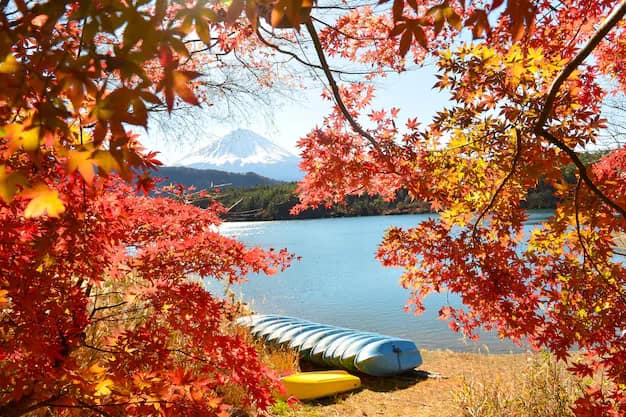
Our practical advice: build in at least two mornings at the lakes, treat the first one as a rehearsal, and go into the trip treating a sighting as a gift rather than an entitlement. Travellers who arrive with that attitude almost always come back happy, including the ones who never saw the summit, because the region is genuinely lovely on its own terms.
The viewpoints, named properly
The Chureito Pagoda at Arakurayama Sengen Park, above Fujiyoshida, is the most photographed Fuji composition in existence — a five-storey vermilion pagoda in the foreground with the mountain rising behind it. You earn it by climbing roughly 400 steps from the shrine below, which is manageable for most people at a slow pace but worth knowing about if you are travelling with elders; our notes on planning a comfortable trip with parents from Gujarat cover how we usually pace days like this. Go at sunrise if you can, both for the light and for the crowd, which builds steadily through the morning.
Oishi Park on the northern shore of Kawaguchiko is the flower viewpoint — lavender beds in early summer, red kochia bushes in autumn, and the lake and mountain lined up behind them. For height, the Kawaguchiko Tenjozan Ropeway, still widely known as the Mt. Kachi Kachi Ropeway, lifts you above the eastern end of the lake in a few minutes and gives you a viewing deck and a short walking trail. Over near Lake Yamanaka, the Fuji Panoramic Ropeway offers a different angle and noticeably fewer people.
Two more places we regularly put into itineraries. Lake Yamanaka for a quieter overnight, with its wide open shoreline and low-rise lodgings. And Saiko Iyashi-no-Sato Nenba, a reconstructed thatched-roof village on the shore of Saiko, rebuilt after the original was destroyed by a typhoon, now housing craft workshops and small museums. It is a good rain plan and a good afternoon when the mountain is sulking behind cloud.
Climbing Fuji, accurately
People ask, so here is the straight answer. The official climbing season is short, roughly early July to early September. Outside it the mountain is closed, the huts are shut, the weather is severe and attempts are genuinely dangerous. Since 2024 the Yoshida Trail on the Yamanashi side has operated an entry fee, a daily cap on the number of climbers and a gate that closes overnight, all introduced to reduce crowding and to discourage the practice known as "bullet climbing" — ascending straight through the night without resting at a hut. Other trails on the Shizuoka side have since brought in charges of their own. These rules are recent and still changing, and you must check the official prefectural sites for current fees, caps and gate timings before committing to a climb. We will not quote figures here, because anything we print will be out of date before you read it.
On the climb itself: Fuji is not a technical ascent, but it is a long, steep, relentless slog on loose volcanic scree at real altitude, typically split across two days with a hut stay. Altitude sickness above the fifth station is common, not exotic. It is not a casual add-on to a sightseeing holiday, and it needs the right footwear, layers, headlamp and an insurance policy that covers high-altitude trekking — worth reading our primer on choosing travel insurance as an Indian traveller before you assume your standard policy applies. If your real wish is to see Fuji rather than to stand on it, stay at the lakes and look up.
Being a good guest on a residential street
The region has had a difficult few years with visitor behaviour at photo spots. The clearest and most widely reported example came in 2024, when the town of Fujikawaguchiko erected a large screening barrier in front of a convenience store because the crowds photographing Fuji above its roofline were spilling into the road, blocking traffic and littering. We mention it not to scold anyone but because it explains what locals are dealing with. Park in actual parking spaces, do not stand in the carriageway, do not block private driveways or shopfronts, keep your voice down early in the morning, and remember that most of these viewpoints are ordinary residential streets where people are trying to get to work. Indian travellers have a very good reputation in Japan and it costs nothing to keep it.
Getting there from India, and the JR Pass trap
There are no direct flights from Gujarat to Japan. Realistic routings go through a Gulf hub such as Dubai, Abu Dhabi or Doha, or eastward via Singapore, Bangkok, Hong Kong or Seoul, landing at Tokyo Narita or Haneda. Depending on the season, connecting via Mumbai or Delhi may open better fares than starting from Ahmedabad — we work through that comparison for every client, and our rundown of international routes out of Gujarat's airports explains the usual trade-offs, alongside our practical tactics for finding cheaper long-haul fares from India.
From Tokyo there are two sensible ways to reach the lakes. The highway bus from Shinjuku Expressway Bus Terminal runs direct to Kawaguchiko in roughly two hours and is usually the simplest option, with luggage stowed underneath and no changes. Or you take the train, transferring at Otsuki onto the Fujikyuko Line for the last stretch. Here is the mistake we correct most often: the Fujikyuko Line is a private railway and is not covered by the Japan Rail Pass. JR Pass holders assume the journey is free, then pay for the final leg anyway and arrive later than the bus would have got them there. For most itineraries the direct bus is both cheaper and faster. Note too that JR Pass pricing changed substantially in October 2023, so the old rule of thumb that a pass always pays for itself no longer holds — it needs a per-itinerary calculation, which we run for clients before anyone buys one.
Visas, for Indian passport holders
Japan requires a visa for Indian passport holders. Applications go through the embassy, a consulate, or an accredited agency depending on your jurisdiction, and the documentation typically covers passport validity, photographs to specification, the application form, a day-by-day itinerary, hotel and flight bookings, proof of funds through bank statements, and employment or business evidence. Japan has also been rolling out an electronic visa for certain applicants, with eligibility differing by jurisdiction and application route.
Requirements, fees and processing times change, and they change without much notice. Verify the current position before you book anything non-refundable. Our Japan visa assistance for Indian applicants covers the file preparation end to end, and the documentation walkthrough written for applicants in Gujarat explains what the itinerary and funds evidence should actually look like. If you are curious about what else a Japan visa can unlock, we have a separate note on destinations that accept a valid Japan visa.
Seasons, and what each one gives you
Cherry blossom reaches the Chureito Pagoda around mid-April, later than Tokyo because of the altitude — an important detail if you are chasing sakura and working from Tokyo's dates, which is why we always cross-check against our national guide to sakura timing and where to see it. The Fuji Shibazakura Festival, a hillside of moss phlox in pink and white below the mountain, runs roughly mid-April to late May. Lavender fills Oishi Park in early summer. November brings red kochia and the maples of the Momiji Corridor along the lakeshore. And deep winter gives you a fully snow-capped mountain in the clearest air of the year, with the fewest crowds — cold, yes, but our favourite season here by some distance.
Getting around, and dressing for it
The region is spread out and the sights are not walkable from one another. The retro-styled sightseeing buses that loop between the station, the lakeshores and the main viewpoints are the practical way around without a car, and a day or two-day pass usually makes sense. If you do want to drive, you need an International Driving Permit arranged in India before departure — a foreign licence alone will not do — and Japan drives on the left, the same as India, which most of our clients find reassuring after the first roundabout. Avoid arriving on weekends or Japanese public holidays if you can; the roads in from Tokyo clog badly. Finally, the altitude makes this region noticeably colder than Tokyo. Layers matter even in spring, and evenings by the lake bite. Our general packing checklist for international trips has the base list; add a warm layer beyond what Tokyo suggests.
Eating well, including vegetarian and Jain
The regional dish is hoto, a thick flat-noodle stew in miso broth with pumpkin, mushrooms and root vegetables, served in an iron pot. It is exactly what you want after a cold morning at a viewpoint. It is also usually built on a pork or bonito dashi base, so it has to be asked about rather than assumed. That is the recurring theme for vegetarian travellers in Japan: bonito dashi hides inside a great many dishes that look entirely plant-based, including miso soup, most noodle broths and many simmered vegetable dishes.
The reliable routes are shojin ryori, the Buddhist temple cuisine that is vegetarian by construction; tofu in its many forms; vegetable tempura, checking the frying oil; inari sushi and avocado or cucumber maki; and convenience store staples, which in Japan are far better than the term suggests. Carry a written card in Japanese explaining what you do not eat — we prepare these for clients. A strict Jain traveller should plan seriously rather than improvising: research restaurants in advance, book accommodation with a kitchenette where possible, and carry theplas, khakhra, dry snacks and ready-to-eat packs. It is entirely doable, but not casually.
Budget, and how we shape the trip
As an indicative range only, a 10 to 14 day Japan trip from Gujarat, including flights, mid-range accommodation, intercity transport, entries and meals, tends to land somewhere around ₹1,80,000 to ₹3,50,000 per person, with peak sakura and autumn dates pushing towards the upper end and shoulder seasons sitting well below it. Ryokan stays with kaiseki dinners, private transfers and premium cabins move the number considerably. Treat this as a planning bracket rather than a quote; we cost every itinerary individually. Two things that genuinely reduce friction on the ground are sorting foreign exchange and card strategy before departure and arranging an eSIM for data from the moment you land, because navigation and bus timetables here are far easier with a live connection. For a fuller view of what a Japan trip costs to assemble, see our approach to budgeting a long-haul holiday from Gujarat.
On shape: we recommend two nights at Kawaguchiko inside a 10 to 14 day Japan trip, not a day trip from Tokyo. The arithmetic is simple. A day trip gives you one afternoon at the mountain, which is statistically the worst time of day for visibility. An overnight gives you two mornings, which is the best time of day, twice. It also lets you enjoy an onsen in the evening and see the lake without the tour coaches. Slotted after three or four nights in Tokyo, it makes a natural pause before you continue west — pairing neatly with the temple neighbourhoods and gardens of Kyoto and slotting into the framework we describe in our seven-day Tokyo to Kyoto to Osaka route. First-time visitors may also want our broader orientation to travelling in Japan from India before drilling into any one region.
If you want this planned properly — the visa file, the routing from Ahmedabad or Mumbai, two nights at the right lake, buses instead of an unnecessary rail pass, and restaurants that will actually feed a vegetarian family — speak to our travel consultants in Surat or look through the Japan itineraries we build for travellers departing from Surat. We cannot promise you the mountain. We can promise you are standing in the right place, on the right mornings, with everything else already handled.