Most first-time visitors to Seoul arrive with one palace in their head and treat the rest as optional. That is an understandable mistake, and it costs people the best day of their trip. Seoul has five Joseon-dynasty palaces, built between the late fourteenth and the early seventeenth centuries, and they are not five versions of the same thing. They differ in scale, in mood, in what survived, and in what you are meant to do when you get there. Once you understand what each one is for, the historical core of Seoul stops being a checklist and becomes the most rewarding two or three days of a Korea trip.
We plan a fair number of East Asia itineraries out of Gujarat, and Korea has quietly become one of the destinations our clients ask about most — partly because it is reachable, partly because the food and the shopping travel well with Indian families, and partly because the palaces photograph beautifully in a way that other capitals struggle to match. This is our working guide to them.
The five palaces, and what each one is actually for
Gyeongbokgung is the grand principal palace, founded in 1395 as the seat of the new dynasty. It is the biggest, the most formal, the most photographed, and the one to build your day around. Changdeokgung is the one UNESCO inscribed on the World Heritage list, and deservedly so — rather than imposing a rigid grid on the ground, its builders let the buildings follow the contours of the hillside, and behind it lies the Huwon, the so-called Secret Garden. Changgyeonggung sits immediately beside Changdeokgung and shares a wall with it; under Japanese colonial rule it was converted into a zoo and botanical garden, a humiliation the site has spent decades recovering from. Deoksugung is the small, central, unusually approachable one, where Korean wooden halls and Western neoclassical buildings stand within a few steps of each other, a physical record of Korea's late-nineteenth-century encounter with the outside world. Gyeonghuigung is the least restored of the five, quiet and largely uncrowded, and honestly the one to skip if your days are short.
In practical terms: Gyeongbokgung for grandeur and ceremony, Changdeokgung for the garden and the landscape sense, Changgyeonggung as a calm extension of Changdeokgung on the same walk, Deoksugung for an easy hour in the middle of the city, and Gyeonghuigung only if you are a completist.
Gyeongbokgung in detail
Enter through Gwanghwamun, the great southern gate, and the axis opens ahead of you: courtyard, gate, courtyard, and then Geunjeongjeon, the throne hall where kings held state audiences and received foreign envoys. It is an austere, enormously dignified building, and standing in the stone-flagged courtyard with the ranked officials' markers underfoot is the moment most visitors remember. Further in, Gyeonghoeru is the banqueting pavilion set on its own artificial pond — a broad wooden hall on stone pillars, reflected in still water, and the single most photogenic structure in the complex. On the grounds you will also find the National Folk Museum and the National Palace Museum, both worth an hour if the weather turns or if you want context before you walk.
Time your arrival for the changing of the royal guard at Gwanghwamun. It runs at set times on most days, with drums, banners and period uniforms, and it is genuinely worth arranging your morning around rather than catching by accident. Because the schedule can be adjusted for weather, ceremonies and maintenance, check the current timings on the day — our team confirms this for clients before they set out, and we would say the same to anyone planning independently.
The honest history behind what you are looking at
This part matters, and it is better said plainly. The palaces were burned during the Japanese invasions of the 1590s and rebuilt over the following centuries. Then, during the colonial occupation from 1910 to 1945, they were systematically dismantled. Gyeongbokgung lost the overwhelming majority of its buildings. A Japanese colonial government building was erected directly in front of the throne hall, blocking the historic axis, and it stood there until it was demolished in the 1990s.
So what you walk through today is very substantially a reconstruction, and one that is still in progress — new halls and gates continue to be rebuilt from records and archaeology. That is not a criticism of the site. It is precisely why the site matters to Koreans: the rebuilding is itself the story. Knowing this changes how you look at a freshly painted beam, and for the better.
Changdeokgung and the Secret Garden — book this first
If you take one planning point from this article, take this one. The Huwon, the Secret Garden behind Changdeokgung, cannot be wandered into. Access is by timed guided tour only, in limited numbers, with English-language tours at set times each day, and those slots book out — particularly in the autumn colour season and around Korean holidays. Reserve online well in advance rather than assuming you can turn up and join. Travellers who leave it to the day routinely find every English slot gone and end up seeing the palace but not the garden, which is the wrong way round.
The garden itself is a series of ponds, pavilions and wooded paths laid out to be discovered gradually rather than surveyed at a glance. It is the clearest surviving statement of what Joseon-era designers thought a landscape should feel like, and in November it is extraordinary. Note that the Huwon tour is ticketed separately from ordinary palace entry — plan for both.
Hanbok, and the free-entry custom
Visitors wearing hanbok, the traditional Korean dress, generally enter the palaces without paying. Rental shops cluster thickly around the gates at Gyeongbokgung and near Bukchon, and for most of them the price includes hair styling and accessories. It is enormously popular with families, it delights children, and it is what produces the photographs people actually frame when they get home. Indian families in particular tend to enjoy it — the shops are used to a wide range of sizes and are relaxed about groups.
Two practical notes. The rules on what counts as qualifying hanbok can be specific — there are expectations around the combination of garments and how they are worn, and modernised or fusion styles are not always accepted — so ask at the rental shop, which will know exactly what passes at the gate. And leave more time than you expect: dressing and hair take a while, and the shops are busiest mid-morning.
Tickets, closing days and the classic wasted morning
Each palace sells its own entry ticket, and there is also an integrated combination ticket that covers several of the palaces plus Jongmyo Shrine. If you plan to see more than two sites, the combination ticket is clearly better value and saves queueing repeatedly. Entry prices at these sites are modest by international standards, but we would rather you check the current figure at the ticket window than quote you something that has changed.
The more important point is closures. Most of the palaces close one day a week — commonly Tuesday, but it genuinely varies by site, and Changdeokgung and Gyeongbokgung do not always rest on the same day. Arriving at a locked gate is the classic wasted morning in Seoul, and we have seen it happen to well-organised people. Check each palace's closing day for the specific dates of your visit and build the sequence around it. Free English-language guided tours run at set times at the major palaces and are excellent value for the context they give — worth aligning your entry time with one.
What sits alongside the palaces
Bukchon Hanok Village occupies the slope between Gyeongbokgung and Changdeokgung, a grid of narrow lanes lined with traditional tiled-roof houses and framed views back over the city. It is beautiful, and it is also a residential neighbourhood where people live ordinary lives. Residents have suffered real disruption from over-tourism, and there are posted quiet hours and signposted restrictions on some lanes. Keep voices down, do not enter private courtyards or gateways, do not photograph into homes, and observe the posted hours. It costs you nothing and it is the difference between being a guest and being a nuisance.
Jongmyo Shrine, also UNESCO-listed, is where the royal ancestral tablets are enshrined and where the ancestral rites — with their own music and choreography — are still performed. It is a more solemn, less decorative experience than the palaces, and it is included on the combination ticket. Insadong, a short walk away, is the district for traditional crafts, paper, ceramics and tea houses, and it makes a good afternoon after a morning of walking. For food, Gwangjang Market is the classic Seoul market experience — dense, loud and excellent.
Getting to Seoul from Gujarat
Korea is one of the East Asian destinations Indians can sometimes reach without a connection: direct flights operate from Delhi and Mumbai to Seoul Incheon (ICN) on Korean carriers. From Gujarat, most travellers position to Delhi or Mumbai for those, or take a one-stop routing through a Gulf hub, Bangkok, Singapore or Hong Kong, which often prices better and gives more departure choice. Our international flights from Gujarat airports overview sets out how Surat, Ahmedabad and Vadodara connect outward, and smart ways to find cheaper airfares from India covers the timing and routing tricks that actually move the price. Check your through-baggage carefully on multi-carrier itineraries — the rules in our baggage allowance explainer for Indian departures apply squarely here.
From Incheon, the AREX train runs into central Seoul, with a slower all-stops service and a faster direct one, and airport limousine buses serve hotel districts directly and are easier with heavy luggage. Once in the city, Seoul's metro is one of the best in the world: clean, punctual, signed in English, and cheap. Buy a T-money card at the airport or any convenience store, top it up, and use it for metro, buses and even some taxis. It removes almost all friction from moving around, and the palaces are all within a short walk of a station.
Visas: verify before you book
South Korea requires a visa for Indian passport holders in most cases. The general mechanism is an application through the Korean embassy, consulate or a designated visa application centre, supported by documentation of the usual kind: a passport with adequate remaining validity, photographs to specification, the completed form, a confirmed itinerary and accommodation, proof of funds, and evidence of employment or business. Korea also operates K-ETA, an electronic travel authorisation, whose applicability to particular nationalities has been changed repeatedly and temporarily waived for some — and at various times Korea has offered simplified or group-tour arrangements for Indian travellers.
We are deliberately not stating fees, permitted stay durations or K-ETA applicability as fixed facts, because these have moved more than once. These rules change frequently and must be verified with the Korean embassy or the official portal before you book flights. Our South Korea visa requirements page for Indian applicants is kept current, the full country-by-country visa desk covers the rest of your itinerary, and if the terminology is new to you, how e-visas, visa-on-arrival and embassy applications differ explains the categories. Travellers from Surat who would rather hand the paperwork over can work with our visa documentation team in Surat.
When to go, and what the seasons really feel like
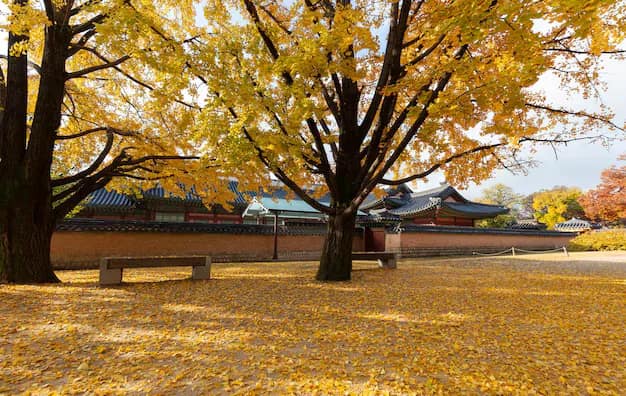
Two windows stand out. Spring blossom in April brings cherry and magnolia against the palace walls. Autumn colour from late October through November is the classic image — maples and ginkgo turning gold and red against grey tiled roofs — and it is the season we recommend most often. Book earlier for autumn; it is peak domestic travel time too, and the Huwon tours go first.
Be warned about summer. Seoul's June-to-August humidity genuinely surprises people who assume East Asia is milder than Gujarat — it is hot, sticky, and includes a monsoon season with heavy, sustained rain. Walking large gravelled palace courtyards in that is unpleasant. Winter is cold and dry, with a stark, uncrowded beauty and very good light, but the days are short and you will want serious layers, which most travellers from Gujarat do not own. Whatever the season, what to actually pack for an international trip will save you buying things at Seoul prices.
Etiquette, comfort and food
Remove shoes where indicated. Do not touch or lean on painted woodwork — the pigments are fragile and much of it is recent restoration work. Stay off roped areas and raised stone platforms unless signed otherwise. Practically, the grounds are large, gravelled and exposed, with little shade in summer and little shelter in rain, so comfortable walking shoes matter more than anything else you bring, along with a hat, sunscreen or a compact umbrella depending on season.
On food, we will be direct because glossing this helps nobody: Korean cuisine is heavily built on meat and seafood, and the side dishes are a trap as much as the mains. Most kimchi contains fermented shrimp or fish sauce, and a great many broths are anchovy- or beef-based even when the visible ingredients look vegetarian. The reliable routes are Buddhist temple cuisine (sachal eumsik), which is genuinely vegetarian and often excellent; bibimbap ordered without meat and egg; japchae; tofu stews specified without seafood stock; pajeon (savoury pancake) checked for seafood; and the cluster of Indian restaurants in Itaewon when you want something familiar. A strict Jain traveller should plan carefully — garlic and onion are foundational to Korean cooking, not optional garnishes — and will usually be happiest with a mix of temple cuisine, Indian restaurants and self-catering. Learn the phrase for "no meat, no fish, no fish sauce" and carry it written in Korean.
Budget and itinerary shape
As an indicative range only: a reasonably comfortable 7-10 day Korea trip from India, including flights, mid-range hotels, transport, entries and food, tends to land somewhere around ₹1,10,000 to ₹2,00,000 per person, with a leaner build-down closer to ₹85,000 and a comfortable or peak-season version well above ₹2,50,000. Season, how far ahead you book and hotel standard move this more than anything else, so treat those figures as a starting frame rather than a quote. Our step-by-step approach to costing an overseas trip from Gujarat explains how we build these, and carrying and spending money abroad the sensible way covers cards and cash for Korea, where card acceptance is near-universal but a T-money top-up still wants small notes.
For shape: give Seoul three to four days, with the palaces as the historical spine — Gyeongbokgung and the guard ceremony one morning, Changdeokgung and the booked Huwon tour with Changgyeonggung alongside on another, Deoksugung and Jongmyo folded into a half-day. Then take the KTX south to Busan for coast, seafood and a different pace; our Busan travel guide for Indian visitors sets out that leg. Korea also pairs neatly with a Japan segment on a longer trip, which our Japan planning guide from India covers. If this is your first trip abroad, the first-timer's pre-departure checklist for Gujarat travellers is the right place to start, and do not skip why travel insurance is non-negotiable for overseas trips. Travelling with parents? Planning an overseas trip with senior citizens is relevant, because palace grounds involve a lot of walking on uneven stone. Staying connected is easy with an eSIM or local SIM sorted before you fly.
How we can help
The palaces reward planning more than almost anything else in Seoul: a booked Huwon slot, a checked closing day, a guard ceremony timed right, and hanbok arranged in advance turn a good day into the one everyone talks about afterwards. That is exactly the sort of sequencing our team in Surat handles routinely, alongside flights, hotels, the Korean visa file and a realistic day-by-day plan that leaves room to sit down. If you would like us to build a Korea itinerary around your dates, get in touch with our travel consultants or look through our curated tour packages departing from Surat. We are IATA TIDS accredited, we answer the phone, and we would genuinely rather talk you out of a bad travel date than sell you one.