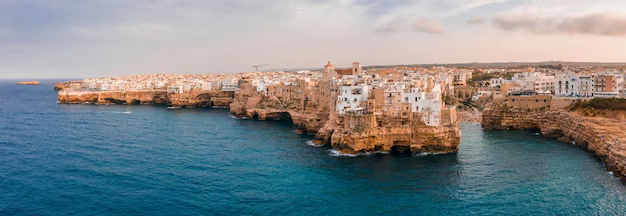
Some Italian towns need explaining. Polignano a Mare does not. It sits on the Adriatic coast of Puglia, about half an hour south of Bari, and it is built directly onto a wall of limestone that drops straight into water so clear you can see the seabed from a balcony forty metres above it. The old town is whitewashed, compact and stacked right up to the cliff edge, with terraces and washing lines hanging over the drop. Underneath, the rock is honeycombed with sea caves that the swell moves through all day.
We send a steady stream of clients from Surat, Ahmedabad and Vadodara to Italy every year, and increasingly they are asking about the south rather than the standard Rome–Florence–Venice line. Puglia is where that curiosity usually lands, and Polignano is often the photograph that started it. This is our honest account of the place: what it delivers, what is oversold, and how to fit it into a trip that makes sense from India.
What the town actually is
Polignano's old town is small. You enter through the Arco Marchesale, a stone gateway that once carried the town's gate, and behind it the streets fold into a tangle of lanes barely wide enough for two people. You can walk the whole thing in twenty minutes if you are brisk about it, which nobody is, because every third alley ends in a terrace over the sea. The pleasure here is not sightseeing in the museum sense. There is no great cathedral to queue for, no gallery you must book. The pleasure is drifting, finding the next viewpoint, and sitting somewhere with a coffee while the water works below you.
That compactness is worth being clear about at the planning stage. Polignano is a half-day to a day of dedicated attention. It is a wonderful place to sleep, wake up early, swim, and eat, but it will not fill a week. Treat it as a base or a stop rather than a destination in itself, and you will love it. Book seven nights expecting a resort experience and you will be restless by day three.
Lama Monachile, honestly
The cove you have seen in every photograph is Lama Monachile, also called Cala Porto. It sits in a ravine between two cliff walls, spanned by an old bridge that carries the line of the Roman Via Traiana. It is genuinely beautiful, and the view down into it from the bridge is one of the great sights of southern Italy.
It is also tiny. This is not a beach in the sense a Gujarati family picturing Goa or Bali would recognise. It is a small pocket of pebbles — not sand, pebbles, some of them large — wedged into a gorge, and in July and August it is packed to the point where finding a free patch of stone is a small victory. There is often a queue of people waiting their turn on the bridge to take the same photograph. None of this makes it a bad place. It just means you should arrive early in the morning, before around nine, or come back in the late afternoon when the day-trippers have gone and the light on the cliffs turns gold. Both windows are transformative.
Swimming here, and along the rest of the coast, is from pebbles and rock rather than sand. Water shoes are not a fussy accessory; they are the difference between a comfortable swim and hobbling out with a cut foot. Pack a pair. Our complete international travel packing checklist covers the rest of what a coastal Italy trip actually needs.
The sea caves and the boat trip
If you do one paid thing in Polignano, make it the boat trip. Small operators run short cruises from the little harbour along the base of the cliffs and into the grottoes, and this is the only way to see the town the way its geology intended — from the water, looking up at the houses balanced on the rock, with the caves opening black and echoing beside you. It reorganises your sense of the place entirely.
Two practical notes. Trips are weather-dependent and are cancelled outright when there is swell, which can happen even on a bright day, so build a spare afternoon into your stay rather than pinning the boat to your last few hours. And the smaller boats get further into the caves than the larger ones, so ask what you are booking. Prices vary by operator, season and boat size; we would rather you ask locally on the day than plan around a number we invented.
Grotta Palazzese: the honest verdict
You will see it on Instagram before you see it anywhere else — a restaurant set inside a cave in the cliff face, tables under a natural stone vault, the sea below. Grotta Palazzese is a real place and the setting is genuinely extraordinary. There is nothing else quite like it in Italy.
We will also tell you what our clients and a great many reviewers report: it is famously expensive, and the food is widely considered not to match the price or the surroundings. You are paying for the room, not the kitchen. Some travellers come away thrilled anyway, because the setting alone was worth it to them, and that is a completely reasonable position. Others feel stung. Go in knowing which of those you are likely to be, book well ahead if you want a summer table, and treat it as an experience purchase rather than a dinner. If your priority is eating well, Puglia will feed you better elsewhere for a fraction of it.
Volare, and the man on the seafront
On the seafront stands a bronze statue of a man with his arms flung wide. That is Domenico Modugno, who was born in Polignano in 1928 and who wrote and sang "Nel blu, dipinto di blu" — the song the whole world knows as "Volare". It became one of the most successful Italian songs ever recorded, and the town has never let go of him.
The connection is not a marketing invention. You will hear the song drifting out of bars, you will see his lyrics painted on walls around the old town alongside other verses, and locals speak about him with genuine pride. Standing at that statue with the Adriatic behind it, arms out like his, is a small ritual almost every visitor performs, and it is worth doing without irony. It is a lovely piece of a small town's identity.
Cliff diving: watch, do not imitate
Polignano hosts a stop on the Red Bull Cliff Diving World Series, and images of divers falling past those white houses have become part of how the town is marketed. If your dates coincide with the event, it is a spectacular thing to witness.
Please do not copy it. Those are professional athletes diving from surveyed platforms into water whose depth has been measured, with safety divers in position. Along the ordinary cliffs the depth varies sharply, submerged rock is not visible from above, and the swell changes what is under the surface hour to hour. People are seriously injured doing this every season. Watch the professionals, swim from the coves, and leave the jumping to them.
What is nearby, because you will want more
Polignano's smallness is solved by its neighbours. Monopoli is a short hop down the coast — a bigger, less photographed old town with a working harbour full of blue boats, a good cathedral and better everyday restaurants. Bari, to the north, has a substantial old quarter and the Basilica di San Nicola, which holds real significance for Orthodox pilgrims and is a genuinely atmospheric building. Inland lies the Valle d'Itria, the valley of dry-stone walls, olive groves and conical-roofed trulli houses; our Alberobello and the trulli of Puglia guide covers that side of the region properly. Further west, across the regional border, Matera and its cave dwellings make one of the most extraordinary day trips in southern Italy.
That cluster is why we generally build Polignano into a Puglia loop rather than treating it as a standalone. If you are still deciding how Puglia fits into a wider trip, our overview of planning an Italy holiday from India sets out how the north and south combine.
Getting there from Gujarat
There are no direct flights from India to Puglia. The realistic routings are a Gulf hub — Dubai, Doha, Abu Dhabi — or a European carrier's hub, connecting into Bari (BRI), which is the natural airport for Polignano, or occasionally Brindisi further south. The alternative is flying into Rome or Milan and continuing by a short domestic flight or by high-speed train down to Bari, which is slower but scenic and lets you split the trip between north and south. From Surat, most itineraries begin with a domestic hop to Mumbai or Ahmedabad; our notes on flying internationally out of Gujarat's airports explain how those connections stack up, and our practical advice on booking cheaper international flights is worth reading before you fix dates.
Once you are in Bari, Polignano is roughly thirty to forty minutes away by regional train, and the station sits a short walk from the old town. That matters more than it sounds. Most of Puglia genuinely requires a car; Polignano does not, which makes it one of the easiest bases in the region for travellers who would rather not drive abroad.
If the Valle d'Itria, Ostuni and the smaller hill towns are on your list, a rental car does become necessary. Two warnings there. An International Driving Permit is required alongside your Indian licence — arrange it before you leave, as you cannot get one abroad. And every historic centre in Italy has a ZTL, a limited-traffic zone monitored by cameras; drive into one without a permit and the fine arrives at your home address months later, often with the rental company's admin charge attached. Park outside the walls and walk in. Always.
Visa, paperwork and timing
Italy is a Schengen country, so Indian passport holders need a Schengen visa. The logic of the file matters more than the length of it: confirmed return flights, confirmed accommodation for every night of the stay, financial documents that show you can fund the trip and have reason to return, and travel medical insurance meeting the mandatory Schengen cover threshold. If Italy is where you will spend the most nights, Italy is where you file. Our Italy Schengen visa requirements page sets out the current document list, and the wider Schengen visa process explained for Gujarat applicants walks through appointments and biometrics step by step.
Start roughly eight to ten weeks before departure. Summer appointment slots in Mumbai and Ahmedabad fill fast, and a rushed file is a weak file. If you have been refused before, understanding why Schengen applications get rejected and how to reapply is the right place to begin rather than simply resubmitting the same papers. The EU has also been rolling out biometric entry–exit procedures at external borders, which can add time at first arrival; we cover what that means in the EU's new biometric border system for Indian travellers. Rules and fees change, so verify current requirements before you travel — we do not quote fee figures here for exactly that reason. Insurance is not a formality either; read what travel medical cover should actually include before you buy the cheapest policy on offer.
When to go
May, June, September and early October are the sweet spot. The sea is swimmable, the crowds are manageable, and the heat is warm rather than punishing. Late September in particular is our quiet favourite: the water is still holding summer's warmth and the town has exhaled.
July and August are hot and genuinely packed, and not only with foreign visitors — this is when Italians themselves holiday in Puglia, so the pressure is domestic as well as international. Mid-August brings Ferragosto, when a great many businesses close and the coast is at its fullest. Winter is the opposite extreme: quiet, many places shut, some boat operators dormant. It is not a swimming season, but the Adriatic in a winter storm hitting those cliffs is genuinely dramatic, and if you want the old town almost to yourself, that is when you get it.
Eating well, including without meat
Here is the positive case, and it is a strong one: Puglia is among the best regions in Italy for vegetarians. This is a poor-farmer cuisine built on vegetables, grain and olive oil rather than meat. Orecchiette with cime di rapa — little ear-shaped pasta with bitter greens — is the regional dish. Burrata comes from Andria, right here in Puglia, and eating it a few hours old is a different food from what reaches India. There is focaccia barese, thick and studded with tomato and olive; fava bean purée with wild chicory, which is peasant cooking at its most satisfying; grilled vegetables; and tomatoes and olive oil of a quality that makes a plain salad worth ordering. For dessert, look for the local sporcamuss, a cream-filled pastry whose name roughly means "dirty your face", which it will.
Now the candour. Polignano is a fishing town, and seafood dominates most restaurant menus — you will need to look past the headline dishes rather than assume the vegetarian options are equal in number. Italian cheese frequently uses animal rennet, so if that matters to you, ask specifically rather than assuming. And a strict Jain traveller will find onion and garlic foundational to nearly everything cooked here; the workable approach is simple grilled vegetables, plain pasta with oil, bread, fresh cheese where acceptable, and fruit, plus a supply of familiar food from home for the days when it does not work out. We help clients pre-brief hotels on this and it makes a real difference. If you are travelling with parents, our guide to taking senior citizens abroad from Gujarat covers food, pacing and medical planning together.
Practicalities people wish they had known
The old town is stepped, cobbled and closed to vehicles. Wheeled suitcases are a struggle on those stones, and if anyone in your group has limited mobility or uses a stick, a room deep inside the old town is a daily ordeal rather than a charming inconvenience. Say so when booking; there is accommodation just outside the historic core with easier access, and we would rather place you there than have you fight the steps twice a day.
Lunch closures catch Indian visitors out constantly. Many kitchens shut from roughly one in the afternoon until around four, and if you wander out at two-thirty expecting a meal you will find shutters. Eat on Italian time or carry something. The currency is the euro and cards are widely accepted, though small bars and beach kiosks still like cash — our forex and money handling guide for international trips explains the sensible mix. For connectivity, sorting an eSIM or international SIM before departure is far cheaper than roaming, and you will want maps constantly in the Valle d'Itria.
Budget and itinerary shape
As an indicative range only: a week to ten days in Puglia from India, including flights, mid-range hotels, some meals out, local transport and a rental car for part of the trip, tends to land somewhere around ₹1,60,000 to ₹2,80,000 per person, with shoulder-season travel at the lower end and peak August at or above the top. Budget-conscious travellers using guesthouses and trains can go below that; anyone wanting boutique masserias will go above. Treat these as planning brackets, not quotes — airfare alone swings enormously by season and booking date. What we can say with confidence is that Puglia offers markedly better value than the Amalfi Coast for a comparable coastal experience. Our structured approach to budgeting an international trip from Gujarat breaks the maths down properly.
For shape, we usually suggest two nights in Polignano inside a seven to ten day Puglia trip: Bari at either end, Polignano and Monopoli on the coast, then inland to the Valle d'Itria for Alberobello and Ostuni, a night or two for Matera, and Lecce in the south if time allows. That also works beautifully as the second week of a longer Italy holiday — pair it with a northern week taking in Florence and the hill towns of Tuscany or the coastal villages of Cinque Terre, then fly or take the fast train south. First-timers to Europe may want to read our suggested first-trip itinerary structure for Indian travellers before committing to a route.
Let us help you build it
Polignano rewards people who arrive with the right expectations: a small, spectacular town, a crowded little pebble cove best visited at the edges of the day, an unmissable boat ride into the caves, and a coast that becomes a proper holiday once you use it as a base. That is a trip worth taking, and it is one we enjoy putting together.
Our team in Surat handles the whole chain — Schengen documentation and appointments, flights routed sensibly out of Gujarat, hotels chosen with steps and luggage in mind, and a Puglia route that does not have you driving in circles. If you would like us to price and plan it, get in touch with our travel consultants or ask about our curated tour packages departing from Surat. We will tell you honestly what a trip will cost and where the crowds will be, before you book anything.