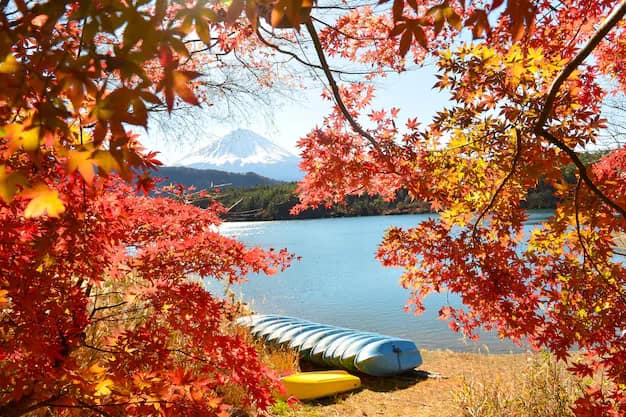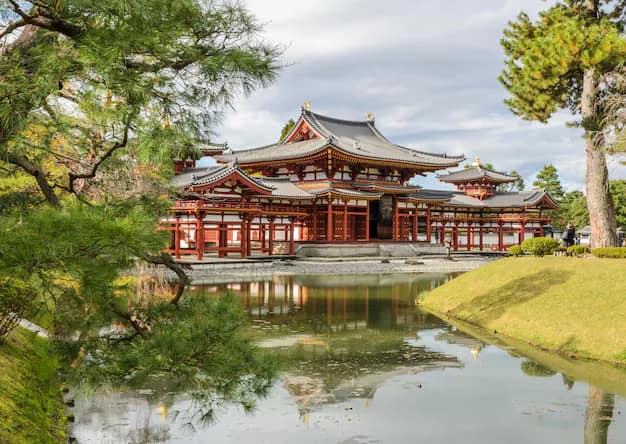
Almost every client who books a Japan trip through our office in Surat ends up asking the same question somewhere around day three of planning: where do we go to actually slow down? Tokyo is thrilling and exhausting, Kyoto is beautiful and busy, and somewhere between the two most people want one night where nobody has to catch anything. That night is usually Hakone.
Hakone sits in Kanagawa prefecture, about ninety minutes west of Tokyo, inside Fuji-Hakone-Izu National Park. It is a hot-spring region, an old checkpoint town on the Tokaido road, an unlikely cluster of world-class art museums, and — under all of it — a volcano that is still very much awake. It has been a spa retreat since the Edo period, when travellers walking between Edo and Kyoto stopped here to soak. That continuity is part of its charm, and it is also why the place is so well organised for visitors.
A caldera that never quite cooled
Geologically, Hakone is a caldera — the collapsed remains of an ancient volcano. Lake Ashi, or Ashinoko, fills part of that basin, and steam still vents from the sulphur field at Owakudani on the ridge above. The heat underground is what feeds the hot water, and the hot water is what built the towns: Hakone-Yumoto at the bottom of the valley where the trains arrive, Miyanoshita halfway up with its grand old hotels, Gora where the mountain railway ends, and Sengokuhara spread across the open highland in the north.
None of these are large. Hakone is a scatter of small settlements linked by steep roads and a remarkable amount of public transport, and it rewards people who treat it as one connected place rather than a single destination.
The Hakone Round Course: one loop, six ways to travel
The thing that makes Hakone genuinely unusual is the Round Course. It is a loop around the caldera stitched together from six different modes of transport, each one covering a stretch of terrain the previous one could not. It sounds gimmicky written down. It is not — it is a sensible engineering answer to a very steep landscape, and it happens to be enormously fun.
The standard direction runs like this. You arrive at Hakone-Yumoto by train. From there the Hakone Tozan Railway climbs to Gora — a switchback mountain line where the train stops, the driver and guard swap ends, and it reverses up the next section of hillside. From Gora a cable car (a funicular, hauled on a rail up the slope) lifts you to Sounzan. At Sounzan you change to the ropeway, a gondola that swings over the ridge and directly above the steaming vents of Owakudani before descending to Togendai on the shore of Lake Ashi. There you board a sightseeing boat across the lake to Motohakone or Hakone-machi. And from the lake a bus brings you back down to Hakone-Yumoto.
The Hakone Free Pass, an Odakyu product, covers every leg of that loop plus local buses and gives discounts at many museums and attractions. Doing the circuit in one direction is standard practice, and we recommend it — going against the flow means fighting queues at every transfer. Allow most of a day if you want to stop properly, and remember that each leg has its own boarding queue on busy weekends.
Pirate ships and the torii that stands in the lake
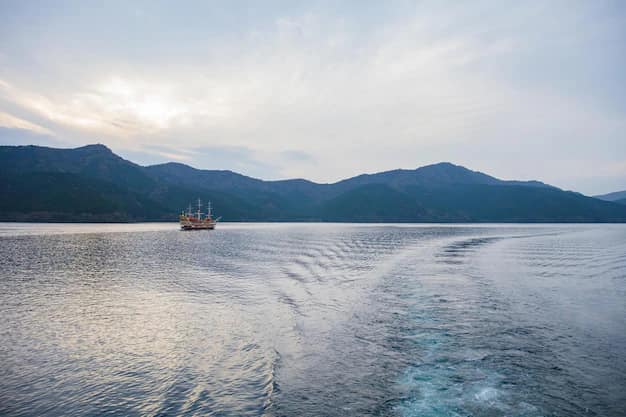
Let us be honest about the boats. The Lake Ashi sightseeing vessels are ornate replica sailing ships, gilded and cannon-studded, painted in colours no real galleon ever wore. They are kitsch. They are also completely delightful, and the twenty-odd minutes across the water with the wooded slopes rising on either side is one of the calmest, prettiest stretches of any day trip near Tokyo.
At Motohakone stands the reason most people photograph the lake at all: the vermilion torii gate of Hakone Shrine, planted in the shallows with the water lapping at its base. The shrine itself is up a cedar-lined stairway behind it and is worth the climb. The torii, though, is where everyone goes. Be prepared: there is a marked queue for the photograph, and on weekends and holidays it can run to an hour or more. If that matters to you, go early in the morning before the first wave of day-trippers arrives from Tokyo, or accept a wider shot from further along the shore.
Owakudani, black eggs, and an active volcano
Owakudani is the sulphur valley the ropeway passes over — bare yellow-grey ground, steam pouring out of fissures, and a smell that announces itself well before you arrive. The local speciality is kuro-tamago, eggs boiled in the volcanic water until the shells turn black from the sulphur and iron. Tradition says each one adds seven years to your life. Nobody believes this and everybody eats one.
Now the part that belongs in every Hakone plan and is usually left out. Owakudani sits on an active volcano. Volcanic gas concentrations are monitored continuously, and both the ropeway and the valley walking area are closed at short notice when readings rise or seismic activity increases. This is not theoretical — it has happened repeatedly, including a prolonged closure following volcanic activity in 2015. So build your Hakone day with a fallback: buses run around the caldera and can substitute for the ropeway leg, and the Free Pass covers them. Check the official status on the morning you travel rather than assuming.
Travellers with asthma or other respiratory conditions, and pregnant travellers, should take the posted gas warnings at the site seriously. They are not decorative. If the signs advise a group not to enter the valley area, that advice applies. We flag this to every family we send, particularly those travelling with elderly parents — our notes on planning a trip with senior citizen parents from Gujarat cover the same kind of judgement calls.
Mount Fuji, and the honest odds
The postcard image of Hakone is Fuji rising behind Lake Ashi with the torii in the foreground. When it happens, it is genuinely one of the great views in Asia. It is also genuinely unreliable. Fuji is hidden by cloud far more often than not, and summer haze is particularly unkind. Your best odds are clear winter mornings, roughly December to February, and early in the day before cloud builds over the peak.
We say this plainly to clients because the disappointment is real: many visitors to Hakone never see Fuji at all. If the mountain is the reason you are going, do not stake it on a single afternoon. Build two or three separate chances into the itinerary — a Hakone morning, a Shinkansen window seat between Tokyo and Kyoto, perhaps a Fuji Five Lakes night. Treat any sighting as a gift rather than a booking.
Onsen etiquette, tattoos and private baths
This is the single biggest source of anxiety for first-time visitors, and it is worth explaining calmly rather than mystically. You undress completely in the changing room — swimwear is not worn in a Japanese onsen. You then sit on a low stool at one of the shower stations and wash thoroughly, soap and rinse, before you get anywhere near the bath. The bath is for soaking, not for cleaning. Long hair is tied up so it does not touch the water. The small towel you are given is for modesty walking around and for wiping down afterwards; it does not go into the water, so people rest it on their head or on the rim. Bathing is usually gender-separated. That is the whole of it, and once you have done it once the awkwardness disappears.
Two practical caveats. First, tattoos. Many traditional onsen still refuse entry to guests with visible tattoos, a rule rooted in historical associations rather than any view about you personally. Attitudes are easing: some facilities are explicitly tattoo-friendly, some supply cover stickers for small designs, and private baths sidestep the issue entirely. But it needs checking in advance with the specific property, not on arrival.
Second, communal bathing simply does not suit everyone, and that includes a good number of Indian families we work with. The answer is kashikiri — private baths booked by the hour — or a room with its own rotenburo, an open-air bath on the balcony or terrace. These cost more and the good ones book out early, but they turn the onsen from a source of stress into the best part of the trip. Tell us at the enquiry stage and we will filter for it.
A night in a ryokan is the point
Hakone without a ryokan night is a day trip with extra travel. The ryokan is the experience: a tatami-floored room, low table, yukata robe provided, futon bedding laid out by staff while you are at dinner, and a kaiseki meal of many small seasonal courses served either in your room or in a dining room. It is unhurried, formal in a gentle way, and quite unlike a hotel.
Two honest notes. A ryokan with half-board — dinner and breakfast included — is also the main expense of your Japan trip on a per-night basis, sitting well above a city hotel night. And the timings are fixed and earlier than most travellers expect: check-in windows tend to close in the late afternoon, and dinner is served at a set hour in the early evening. Arriving late means missing the meal you paid for. Plan the Round Course so that you are at your ryokan in good time, not racing the last bus.
Sculpture, glass and pampas grass
The art surprises people. The Hakone Open-Air Museum spreads modern sculpture across a hillside lawn with the mountains behind it, and has a dedicated Picasso pavilion indoors. The Pola Museum, set into the forest near Sengokuhara, holds a serious collection of Impressionist and Japanese work in a building half-buried in the trees. The Venetian Glass Museum is smaller and unashamedly pretty. All three are on Round Course bus routes and covered or discounted by the Free Pass.
In autumn, the pampas grass field at Sengokuhara turns silver-gold and catches the low light — a short, easy walk and a lovely counterpoint to the sulphur and steam higher up. If you are chasing seasons more generally, our guide to cherry blossom season in Japan explains how quickly the timing shifts year to year.
Getting there from Gujarat, and the JR Pass trap
There are no direct flights from India to Japan for most of our clients, so the realistic routings from Ahmedabad or Mumbai run via a Gulf hub, Singapore, Bangkok, Hong Kong or Seoul into Tokyo Narita or Haneda. Connection quality matters more than headline fare here; we usually compare a couple of options against arrival time in Tokyo rather than price alone. If you are starting from Surat, our overview of international flight connections through Gujarat's airports and our notes on smarter flight booking from India are the right place to begin.
From Tokyo, the neat way in is the Odakyu Romancecar from Shinjuku to Hakone-Yumoto, roughly 85 to 95 minutes with reserved seats and, if you book early, the front observation carriage. Here is the trap that catches a surprising number of travellers: the Romancecar and the Hakone Free Pass are Odakyu products and are not covered by the Japan Rail Pass. People arrive assuming the JR Pass covers everything in Japan and are annoyed to find it does not. On top of that, JR Pass pricing changed substantially in October 2023, so whether a rail pass is worth buying at all now needs a per-itinerary calculation rather than a reflex purchase. We run that maths for clients as part of planning a 10 to 14 day Japan route through Tokyo, Kyoto and Osaka.
Visas, money and the practical grind
Japan requires a visa for Indian passport holders. In general terms, applications go through the embassy, a consulate, or an accredited agency, and typically ask for a passport with adequate validity, photographs to specification, the completed form, a day-by-day itinerary, confirmed bookings, proof of funds and evidence of employment or business. Japan has also been rolling out an electronic visa for some applicants, with eligibility differing by jurisdiction and applicant category. Requirements, fees and processing times change, so verify the current position before you book anything non-refundable — we keep the practical detail current on our Japan visa page and in our longer walkthrough of the Japan visa process for Gujarat applicants. Once you hold a Japan visa there are onward possibilities worth knowing about, which we cover in our piece on destinations open to Indians holding a Japan visa.
On the ground, three things matter. Luggage is a genuine problem on the Round Course, because you change mode roughly every thirty minutes and there is nowhere to put a large suitcase on a switchback train or a gondola. Use the takkyubin luggage-forwarding services to send bags ahead to your ryokan or on to Kyoto, or leave them in coin lockers at Hakone-Yumoto and travel the loop with a daypack. Second, Hakone is steep and stepped — stairs, slopes and gravel paths everywhere — which is worth weighing if anyone in your group has mobility limits. Third, while Japan is increasingly card-friendly, cash still gets used at small museums, buses and eateries, and weekends and Japanese public holidays are genuinely crowded. Sorting out foreign exchange and card usage before departure, a working eSIM or international data plan and proper travel insurance cover removes most of the friction.
Eating vegetarian in a seafood kitchen
This deserves a straight answer. Kaiseki is seafood-forward by design, and bonito dashi — stock made from dried fish — is in nearly everything that looks vegetarian, including miso soup, simmered vegetables and dipping sauces. Asking at the dinner table will not fix it, because the menu was planned days earlier and the stock was made that morning.
So the single most useful thing an Indian vegetarian can know about a ryokan is this: declare it at the time of booking, in writing, and let the property confirm. Many ryokan will happily prepare a vegetarian kaiseki with proper notice, using kombu-based stock and vegetable and tofu courses — some do it beautifully. That notice is the whole trick. A strict Jain traveller should plan more seriously still, confirm what can be excluded, and carry supplies such as theplas, khakhra and ready-to-eat packets as backup; that is normal practice, not a failure of planning. Our wider Japan travel guide for Indian travellers goes into food logistics in more depth.
Where Hakone fits, and what it costs
In practice Hakone works best as one or two nights inside a 10 to 14 day Japan trip, slotted between Tokyo and Kyoto so it breaks the journey rather than adding a detour. One night is enough to do the Round Course and sleep in a ryokan. Two nights is what lets you actually use the onsen — a soak on arrival, a soak before dinner, a soak the next morning with the valley in mist — and see a museum without watching the clock. If your itinerary then continues to the temple districts of Kyoto or on to the food streets of Osaka, Hakone is the pause that makes the rest of the trip feel less relentless.
On budget, we give indicative ranges only, because season, routing and hotel standard move the number enormously. A 10 to 12 day Japan trip from Gujarat, including flights, mid-range hotels, rail and reasonable eating, has recently landed for our clients somewhere in the range of roughly ₹2,00,000 to ₹3,50,000 per person, with peak sakura and autumn dates pushing higher and shoulder-season travel lower. A ryokan night with half-board sits well above a comparable city hotel night, so one or two of them shifts the total noticeably. Treat these as planning brackets rather than quotes; our framework for budgeting an international trip from Gujarat explains how we build the estimate line by line.
If this is your first long-haul trip, work through our first international trip checklist for Gujarat travellers before you start booking — it catches the documentation gaps that cause most last-minute panic.
Hakone is a small place that rewards a little forethought: one loop done in the right direction, a ryokan booked with your food requirements already on record, a fallback for the day the ropeway closes, and no expectations placed on Mount Fuji. Get those four right and it becomes the night everyone remembers. Our team in Surat plans Japan itineraries end to end — flights, visa documentation, ryokan selection with vegetarian or Jain meals confirmed in writing, rail pass maths and the Hakone day itself. Come and talk to our travel consultants about your dates, or see how we structure curated tour packages from Surat for families and small groups.