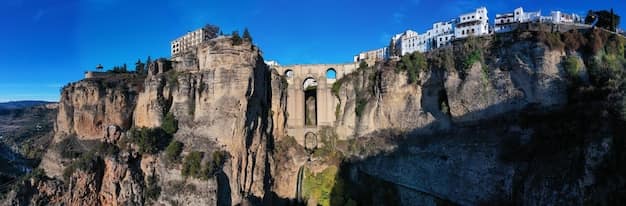
Some towns reveal themselves slowly. Ronda does the opposite: you walk around one corner in the old quarter and the ground simply stops, dropping roughly a hundred metres into the El Tajo gorge while houses cling to the rim as though they have been glued there. Perched in the mountains of Andalusia between Seville and Malaga, Ronda is one of the most photographed small towns in Spain, and yet it stays comfortably walkable, unhurried and affordable compared with the big Spanish cities. For travellers from Surat and the rest of Gujarat, it slots neatly into a southern Spain circuit alongside Seville, Cordoba and Granada, and it works either as a long day trip or, far better, as an overnight stay. Spain sits inside the Schengen area, so the paperwork is the same as for any European trip, and our visa desk in Surat handles the Schengen file end to end. This guide walks through how to reach Ronda, what to see, where it fits in a wider Spain itinerary for Indian travellers, and what to budget.
Getting to Ronda from Seville or Malaga, and the best time to visit
Ronda has no airport of its own. Almost everyone arrives from Malaga (roughly two hours by road, or a scenic but slower train) or from Seville (about two hours by bus or car, with direct trains on a limited daily schedule). From Gujarat, the usual routing is Ahmedabad or Mumbai to Madrid, Barcelona or Malaga with one Gulf or European connection, then onward by domestic flight, train or coach; our team arranges the whole chain of flight bookings from Surat so the connections actually line up rather than leaving you a four-hour gap in Madrid. Driving is the most rewarding option because the approach through the Serrania de Ronda mountains is half the experience, though the final climb involves tight bends and drivers who dislike heights may prefer the bus. On timing, spring (March to May) and autumn (September to early November) are the sweet spot: mild days, green hillsides and comfortable walking weather. July and August regularly cross 35C in inland Andalusia, which is punishing for gorge-side walking, while winter is quiet, cool and occasionally wet but very cheap. If you are still deciding when to fly, our month-by-month Europe weather planner compares the seasons across the continent. Schedules, train frequencies and road conditions change, so verify current timings before you book.
Puente Nuevo and the El Tajo gorge viewpoints
The Puente Nuevo, or New Bridge, is the image that brings most people to Ronda. Completed in the late eighteenth century after decades of work, it spans the El Tajo gorge in three great arches and joins the old Moorish town to the newer quarter. Walking across it takes two minutes; photographing it properly takes half a day. The classic viewpoints are the Mirador de Aldehuela right beside the bridge, the terraces of the Alameda del Tajo park for the cliff-edge panorama, and best of all the path down to the Jardines de Cuenca or the trail descending into the gorge itself, where you finally see the full height of the structure from below. Wear proper shoes for the descent, carry water, and go early in the morning or in the last hour of light when the stone turns honey-coloured and the coach groups have thinned out. There is also a small interpretation centre inside the bridge itself explaining its construction. Two older crossings, the Puente Viejo and the Roman-era Puente Arabe, sit further down the gorge and are worth the short walk for a quieter view.
The old town, Arab baths and Ronda's layered history
Cross the bridge into La Ciudad, the old town, and the streets narrow into whitewashed lanes, wrought-iron balconies and small squares where very little seems to have changed in centuries. Ronda was an important Moorish stronghold until 1485, and that history is written all over the district: the thirteenth-century Banos Arabes (Arab baths) are among the best preserved in Spain, with star-shaped skylights in the vaulted ceilings and the original hypocaust heating system still visible. Nearby are the Palacio de Mondragon with its Mudejar courtyards and city museum, the Casa del Rey Moro gardens with the Water Mine staircase cut down through the rock to the river, and the Iglesia de Santa Maria la Mayor, a church built directly over the town's former main mosque with the mihrab arch still surviving inside. If Moorish Andalusia is what draws you, pair Ronda with the Alhambra palaces of Granada and the Mezquita of Cordoba for the full arc of the story. Most sites are small and cheap to enter, and a combined walking route through the old town fills a relaxed half day.
Ronda's historic bullring: architecture, museum and legacy
The Plaza de Toros de Ronda, opened in 1785, is one of the oldest purpose-built bullrings in Spain and is visited today primarily as a monument and museum rather than as an active venue. Architecturally it is genuinely remarkable: a perfect sandstone circle ringed by a two-tier arcade of sixty-eight Tuscan columns, roofed in old tiles, with one of the widest sand arenas in the country and no seating shadow line breaking the symmetry. The attached museum covers the building's construction, the Romero family who shaped Ronda's place in Spanish cultural history, and the town's long association with writers such as Ernest Hemingway and Orson Welles, who both spent time here. There are also stables, saddlery and historic costumes on display. Entry is inexpensive and includes an audio guide in English. To be clear, we are recommending this as a piece of eighteenth-century architecture and a window into Andalusian social history; we do not promote or arrange attendance at bullfighting events, and many Indian visitors choose to see the ring purely on the architectural and museum tour, which is exactly how it is presented for most of the year.
Pueblos blancos and wine country day drives
Ronda is the natural base for the pueblos blancos, the white villages scattered across the Sierra de Grazalema and the Cadiz hills. Setenil de las Bodegas, about twenty minutes away, has houses built directly under overhanging rock ledges and is the single most striking of the lot. Zahara de la Sierra sits above a turquoise reservoir with a Moorish castle keep on the ridge, Grazalema is the walking and hiking hub with the best mountain scenery, and Olvera, Arcos de la Frontera and Montejaque round out a two-day loop if you have a car. Ronda is also the heart of a small but serious wine region, with more than twenty bodegas within a short drive producing reds from Tempranillo, Syrah and Cabernet in mountain vineyards; most offer tours and tastings, usually by prior appointment, and some can be combined with a village lunch. A hired car gives you the most freedom, but organised half-day excursions run from Ronda too. We can build these drives into a broader southern Spain route as part of our Europe holiday packages so the villages, the wineries and the city stops all connect sensibly.
Food, vegetarian options, budgets and practical tips
Ronda's kitchen is mountain Andalusian rather than coastal: oxtail stew, mountain-cured ham from the surrounding villages, hearty soups, local goat cheese and simple grilled dishes, all cheaper than in Seville or Malaga. Vegetarians will manage comfortably with a little planning. Reliable meat-free choices include gazpacho and salmorejo (cold tomato soups, though salmorejo is often topped with ham, so ask for it without), pisto (a Spanish ratatouille), patatas bravas, tortilla espanola, grilled or fried vegetables, espinacas con garbanzos, padron peppers, olives, bread with tomato and plenty of pasta, pizza and salad options. Two words worth memorising are sin carne (without meat) and sin jamon (without ham), since ham is often treated as a garnish rather than a meat dish. Jain travellers should expect onion and garlic in almost everything and are best served by carrying some ready food and asking us to pre-brief hotels. Ronda is also home to a handful of Indian restaurants and several vegetarian-friendly cafes near the Alameda park. On budgets, expect Ronda to be noticeably cheaper than Spain's big cities for both meals and rooms, with monument entry fees typically in the low single-digit euro range each; we do not quote fixed figures here because prices, exchange rates and fees move constantly, so treat everything as an estimate and verify current rules and rates at the time of booking. Practical points: book accommodation early for spring weekends through our hotel bookings service, carry a card plus some cash for small village bars, wear grippy shoes for the gorge paths, and keep a hat and water with you between May and September. Travel insurance is mandatory for a Schengen application, and our travel insurance cover for Europe meets the requirement; if you want the details first, read our insurance explainer for Indian travellers.
Frequently asked questions
Do Indian passport holders need a visa for Ronda?
Yes. Spain is part of the Schengen area, so Indian nationals need a short-stay Schengen visa for Spain before departure. Applications go through the Spanish consulate's appointed centre, and appointment availability from Ahmedabad and Mumbai can be tight in peak season, so start eight to twelve weeks ahead. Our Schengen documents checklist for Gujarat applicants walks through the paperwork, and rules do change, so verify current requirements before applying.
Is one day in Ronda enough, and where should I stay?
A day trip from Seville or Malaga lets you see the Puente Nuevo, the old town and the bullring, but you will spend four hours in transit and miss the best light. One night is a big upgrade, because the town empties in the evening and the viewpoints become genuinely peaceful. Two nights make sense if you want the white villages and a winery visit as well. Most travellers arrive from Seville, so it pairs naturally with our Seville and Andalusia guide.
Ready to put Ronda into a real southern Spain itinerary?
Explera Vacations handles the whole trip from Gujarat, from routing and rooms to the Schengen file and on-ground drives, backed by our full range of travel services in Surat. Browse our Surat departure tour packages for Europe ideas, or speak to our travel consultants with your dates and we will send a costed plan built around the gorge, the white villages and the wine country.